
Categories
News Trending Viral Worldwide

Andy Hull Reviews Every Manchester Orchestra Album

For the past 15 years, Manchester Orchestra has been one of the most popular emo bands on the planet. The one person who has been there every step of the way is founding singer-songwriter Andy Hull, who started the band when he was in his teens and has charted his own growing-up process with each album.

Manchester Orchestra has also matured a lot over the years, evolving from an intense and volatile post-hardcore outfit on albums like 2009’s Mean Everything To Nothing to the expansive and philosophical indie rock of their latest, The Million Masks Of God, which drops next week. Along the way, they’ve managed to somehow grow their audience while retaining committed fans who connected with the early records as teenagers, including famous acolytes like Phoebe Bridgers and Julien Baker.

“Even though everything did well at that time, it wasn’t really accepted by critics and ‘cool’ people,” Hull recently mused about his back catalogue, “and that totally worked in our favor, because it still holds up. It sounds, to me, pretty timeless.”

That doesn’t mean those albums were easy to make. Ahead of the release of The Million Masks Of God, a song cycle inspired by the death of guitarist Robert McDowell’s father, Hull reflected on every Manchester Orchestra LP, candidly breaking down the myriad fascinating dramas that marked the process of making each record.

I’m Like A Virgin Losing A Child (2006)

Obviously the first thing I remember about that record is how young I was. My voice, when I listen back to that record, I can just hear the youth. My voice actually hadn’t fully changed yet. I just sound really youthful, and I remember it being very difficult. I cared a whole lot about it.

Robert didn’t play on that record. He was an intern at the studio, and joined the band. Basically, we had a guitar player quit, and say that he wanted to join another band while we were making that record. And he’s like, “I’ll finish out the thing, then I can’t play any more shows with you guys.” I had been friends with Robert for a couple years, making music with him in his basement. But he was 16, and I was 19, which is pretty wild to look back on. I was still trying to figure out fucking everything, really. It was the first time we’d ever recorded live. That was pretty foreign to me.

But we didn’t have a label, so there wasn’t pressure. The pressure was all self-imposed. The eight full-band songs on that record were the eight full-band songs the four of us knew how to play. There were no other options. It’s these eight rock songs, and then these three delicate pieces — “I Can Feel Your Pain,” “Sleeper 1972,” and “Don’t Let Them See You Cry.” The acoustic songs on that record were recorded in this enormous freezer that the studio had as an iso booth. So, I would go in there and track 10 or 15 of these solo songs that I had floating around, and we picked those and went from there.

I remember being really surprised that people liked it immediately, and it started to spread in a really organic way. I didn’t really see it happening. I still really like those songs. And I like playing those songs — I’m not embarrassed, lyrically, about those songs, which is helpful. I was still searching around the same parking lots I’m searching around now. I think I just have more matured equipment philosophically. But I like what I was writing about.

Mean Everything To Nothing (2009)

I had gotten married, and then I immediately started writing this record and recording it. My wife and I — I was 21, and she was 22 — had zero idea of what we were doing in our lives. We hadn’t lived together before. There was a tension there that was always kind of brewing. I think that mixed with a crisis of faith and just freaking out. It’s pretty obvious when you listen to that record. Immediately, I let you know what I’m going through at that time. I was just obsessed with stuff like Pinkerton, and this idea of, “How do you make records that are super, super raw, but sound really great and big?”

I had no idea what music production was. By the time that first record came out, and then we just beat it into the ground touring, over and over and over, I started to understand what I was capable of doing, and wanted to spread my wings on the production side of it. I definitely felt like I had something to prove with Mean Everything To Nothing, since the first one had been so unexpectedly well-received. There’s always the fear of the sophomore slump. It’s like, “How do we just destroy that altogether?” Create something that just, in my opinion, blew the first one out of the water.

By the time it came for us to pick a producer, we landed on Joe Chiccarelli, who was on an incredible streak at that time. He’d just worked on the third Shins record, Evil Urges by My Morning Jacket, that second Raconteurs record, and Icky Thump by the White Stripes. So, we were like, “Oh, shit, this guy wants to work with us? Let’s do it!” We didn’t know that we were then entering Joe’s world, which was 25 takes of every single song. Zero room in the initial recording for experimentation. It was all about getting the live thing to where he wouldn’t even need to add anything else. The whole time, I’m thinking, “Man, there’s so much more to this record that we’re not getting here.”

I was pretty dumb as well at the time. When we went down to Atlanta to finish it, Joe left, and I just wouldn’t get back to anybody. Wouldn’t talk to the label, just kept working on this record. Joe would leave these voicemails like, “Where are you?” I wouldn’t call him back, which is terrible. But, I just knew that I had to “save it,” in my mind. So, we brought in Dan Hannon from the last record, and he then let me go crazy. Added all the stuff that I want to add.

Joe did end up coming back. Joe and the band would work from 10:30 a.m. to 10:30 p.m., and then I would work from 11:00 p.m. to the next morning. I brought in an engineer, and put in background vocals, new lead vocals, and added instrumentation. The engineers that I was bringing in were not respectful of ProTools at all, and so they’d come in the next morning and it was like a madman had been there for 10 hours, destroying the organization of all these files. They’d have to sift through all the shit that I’d done.

It ended up, though, being one of my favorite things we’ve done, because it feels like that time to me. It took me a long time to listen back to that record, and actually enjoy it. I remember waiting to do a lot of the vocals until I had gotten sick, so that I could have this really raspy scream, and that’s all over that record. I was smoking so many cigs, too, so it sounds like I’m 35 on that record, and I’m 21.

Simple Math (2011)

We were on a version of Columbia for Mean Everything called Canvasback. Two weeks later, the guy who runs Canvasback was let go from Columbia, and moved from Columbia over to Atlantic with Canvasback. Columbia said, “You can take every band with you except Manchester. They stay.”

So, we now have no real champion. We had a guy that we loved, Jay Harren. But he was an A&R guy, with not a ton of pull. We were sort of lost on an island out there. The good part of that was, they let us make the record that we wanted to make. There was nobody ever checking in on a single, for better or for worse. I felt I was really starting to come into my production brain, and so was Rob. That was the first record me and Rob really got our hands on together.

You can tell it’s pretty dramatic, and you notice how wide we wanted it to go. It was like, “Man, we can afford to have strings!” After Mean Everything, which felt like a pretty punishing record at times, this was a chance to get beautiful, and it was the first record where we stretched as far as we could possibly stretch to see what kind of genres and sounds we could dip our toes into.

England was really great to us. Australia was really great to us on that record, too. But the label was never behind it. The main two guys at that label, Rob Stringer, who ran the whole thing, and then Steve Barnett, who was the president of Columbia, were both really big supporters of our band. But they also were managing Beyonce records, so it wasn’t like they could put all their attention and focus on Simple Math.

I’ll never forget being in the office at Columbia, and playing them the record, and the radio team just having these blank stares on their faces. They had no idea what to do. I was like, “I have a pretty good idea: I think this song ‘Pensacola’ is really catchy.” And, they were like, “No, no, no, it can’t be that, there’s no real chorus to it. We should do ‘Simple Math’ and then also the next week release ‘April Fool,’ so that nobody knows what the single is.”

Cope and Hope (2013)

Cope and Hope ended up being the great palate-cleansers and, really, I think the end of phase one for the band, because they were made with no label. Nobody was telling us what to do. We built our own studio, and started just hacking away at these songs. It felt like the last opportunity to make a record that we always wanted to make, which was just really smart, straightforward, melodic rock songs, and not deviating from that path.

Cope is our “fuck you” record. We knew we wouldn’t get a lot of radio play because nothing was sounding like that on the radio. But we were hearing Thermals records that were super melodic, and really poppy, and engaging, but also really fuzzy. Cope is like that idea.

We got some backlash on Cope, because it didn’t sound as pretty or as clear as the other records. But it also burst through a little more in an interesting way. The shows started to get a little bigger. Even though it was a polarizing record for some people, it did seem to open another door for us.

First we did Cope, and then we did Hope at the same time. We were recording these two albums knowing Cope will come first, and then we were going to release this angelic sibling. Which was really cool, to be able to go back and re-record songs. We were just basically using every tool that we possibly had on those two records.

A Black Mile To The Surface (2017)

There wasn’t a clear idea of what the next step should be, and then that all changed when we made Swiss Army Man. We worked on that for 13 months, so it also gave us time to step away from Manchester and not really worry about it. That was the turning point. I think that when it came time to work on the next record, we had all these different tools in our toolbox, and just mentally could look at the records in a different way.

When we were making A Black Mile, it really felt like it was our first record again, in a cool way. The idea was like, “We’ve learned a ton from these four records we’ve just made, the biggest thing being that we don’t need to rush. Let’s do it right, and make sure every rock is turned, and we can be proud of the thing at the end of the day.” I do think our maturity level, and the way we were all communicating with each other, felt way healthier, even though it was really hard to make. Tthere weren’t arguments or fights during that record. It was more that we were in the trenches trying to be honest with each other when stuff wasn’t working, but not being an asshole about it.

Wilco is one of my favorite bands. I like every song of theirs, whether it’s a rock song or a folk song. I was like, “Why can’t I have that?” I was not going to worry about whether a song was rocking enough, or if it’s basically a folk song at its very core, because I love that kind of music.

I wasn’t the center of my universe anymore on that record, even thematically. The record’s about me, but that record’s also about my daughter, and my parents, and my grandparents, and my daughter’s daughter, and the impending doom of all of it. The fear of that. You know, you’re a dad, you can kind of go down those wormholes of like, “Oh no, I can’t stop time!”

The Million Masks Of God (2021)

It was the happiest that we’ve ever been making an album by far. It was also the saddest because of Robert’s dad’s passing, and the themes on the record and just how heavy all of it was. There was just a really healthy bond between the four guys in the band, and Catherine Marks, and Ethan Guska, who was a really incredible addition to the whole process.

When we were finishing the record at Sound City, where Ethan works a lot, it was us in the B room, and Bob Dylan in the A room finishing his record. I’ll just say this, the vibe was pretty tense. It was just Bob Dylan people everywhere. We were sharing the same common area, but it was like, “Okay, I’m not supposed to be in here.” Even though we were paying a day rate to be here, we shouldn’t be here.

A big part, sonically, going into it, was I knew that I wanted for us to experiment with drums and percussion a lot more, and bring an element that I love about Clinic records and Radiohead records. How do we do that without just sampling stuff over top of the drums? Because our drummer’s so great that I want him to have the tools to be able to actually organically write something.

We ended up building this crazy Frankenstein drum kit that had a bunch of triggers and sounds that we were picking out. We would then record the MIDI data from the drums when we were tracking them, and then assign the MIDI data to other instruments. There’s parts on this record where there’s a keyboard part, but that keyboard part was actually played by Tim on the toms, and we just assigned notes and sounds to it. We liked this weird science experiment process of it.

We knew we really wanted from the beginning for it to be all connected in a similar way as Black Mile, but more thought out, and allowing the songs to fold in on each other. And having repeated melodies and phrases that, at the end of the second song, is the same melody and lyrical nod to the fifth song. That happens all over the record. Throwing out the rule book that we had made for ourselves about even what a song can be. It’s been a really difficult record to pick a single and pick songs to play for people, because I do feel like it’s best served as a whole thing. The album’s the song.

The Million Masks Of God is out on April 30 via Loma Vista. Get it here.
Categories
News Trending Viral Worldwide

‘Mortal Kombat’ Star Lewis Tan Accidentally Wandered Into A ‘Post-Fatality Set’ And Almost Got Sick

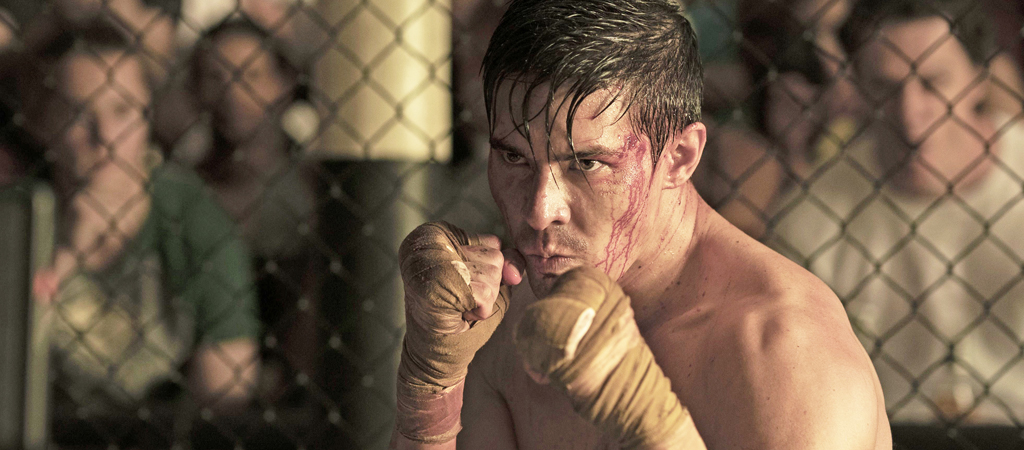
As Mortal Kombat nears its theatrical and HBO Max release on Friday, the filmmakers have been working double time to assure fans of the classic fighting game series that this adaptation will be “unapologetically brutal” when it comes to honoring the franchise’s ultra-violent roots. This time around, Lewis Tan, who plays the new character Cole Young, opened up about the film’s use of practical effects to make the movie’s high-octane fights look realistic even while having an ice ninja fight a guy with robot arms. And based on Tan’s description, it sounds like the Mortal Kombat set had some very messy days. Via Variety:

Of course, when you talk about “Mortal Kombat,” one of the major things you talk about is the fatalities. So how gruesome are the fatalities that you got to witness?

Yeah, they’re pretty gruesome. I walked on set one day and I didn’t know what was going on, and I accidentally walked into a post-fatality set and I felt pretty sick to my stomach. [Laughs.] I was like, “What the hell is this? What happened here?” It looked like somebody destroyed a buffet line, but there was no food.

Tan goes on to elaborate how director Simon McQuoid was absolutely committed to capturing the essence of the video game series, but he also wanted to make sure it worked with the story without going too over the top.

“He was like, ‘This is going to be hard R. Try not to make it NC-17, but let’s take it all the way up until that point.’ And that’s what we did,” Tan said. “But I think he did it really tastefully. He didn’t just try to be super gory and crazy. I’m not into all that, but I think if you’re going to do Mortal Kombat correctly, you’ve got to have it.”

(Via Variety)

Categories
News Trending Viral Worldwide

A Republican Congressman Complained About Cardi B And The FCC On The House Floor

Cardi B often incorporates risqué elements into her music, videos, and performances, which rubs some observers the wrong way. Cardi seems to derive great enjoyment from that, though, like when she recently laughed off the 1,000-plus complaints the Federal Communications Commission (FCC) received regarding her and Megan Thee Stallion’s 2021 Grammys performance. The performance also bothered at least one high-profile politician in the House Of Representatives.

While speaking on the House floor this morning, Republican Representative Glenn Grothman of Wisconsin cited Cardi’s performance while criticizing the FCC and partially blaming them for “the moral decline of America.” He said, “I received complaints in my office, and rightfully so, about Cardi B and the Grammys. They wonder why we are paying the FCC if they feel that this should be in living rooms across the nation. I realize that Kamala Harris has used her fame to promote this performer, but I assure the FCC that millions of Americans would view her performance as inconsistent with basic decency. Wake up, FCC, and begin to do your job! The moral decline of America is partly due to your utter complacency.”

This news is still fresh, so Cardi has yet to respond to it, but based on her past reactions to this sort of criticism, it seems unlikely she will lose any sleep over it.

Some artists covered here are Warner Music artists. Uproxx is an independent subsidiary of Warner Music Group.

Categories
News Trending Viral Worldwide

‘The Conjuring: The Devil Made Me Do It’ Reveals A Terrifying Trailer Based On A Historic Trial

Did you know that The Conjuring Universe is the second highest-grossing horror movie franchise of all-time? The only reason it’s not number one is because there are 35 Godzilla movies ($2.05 billion) compared to only seven for The Conjuring ($1.9 billion).

The Conjuring: The Devil Made Me Do It will soon add to that total.

Set in 1981, the third Conjuring film, starring Vera Farmiga and Patrick Wilson as paranormal investigators Lorraine and Ed Warren, is based on the real-life trial of Arne Cheyenne Johnson, who fatally stabbed his landlord. His defense: the devil made me do it. It’s supposedly the “first time in U.S. history that a murder suspect would claim demonic possession as a defense.” You can watch the creepy trailer above.

Here’s the official plot synopsis.

The Conjuring: The Devil Made Me Do It reveals a chilling story of terror, murder and unknown evil that shocked even experienced real-life paranormal investigators Ed and Lorraine Warren. One of the most sensational cases from their files, it starts with a fight for the soul of a young boy, then takes them beyond anything they’d ever seen before.

The Conjuring: The Devil Made Me Do It, which is produced by James Wan (who also receives a story-by credit), comes to theaters and HBO Max on June 4.

Categories
News Trending Viral Worldwide

Jimmy Kimmel Compared Tucker Carlson To The Joker After Hearing His Maniacal Laugh

Jimmy Kimmel has been so preoccupied with Mike Lindell this week, he almost didn’t notice that Tucker Carlson has turned into the Joker.

In the days since a jury found Derek Chauvin guilty of murdering George Floyd, “many Americans have spoken powerfully and passionately about the verdicts and their significance yesterday, but none spoke less eloquently than Tucker Carlson of Fox News. Tucker had a former-New York City prison official on his show, and when the officer dared to use the word ‘savagery’ to describe what Derek Chauvin did, Tucker had a little explosion in his head,” as you can see (and hear) here.

“What the hell was that?” Kimmel wondered after playing the clip during Wednesday’s episode. “It’s like there’s a little girl trapped in his head, right? He laughs like the villain in the movie who realizes James Bond just put the bomb back on him, and he’s about to explode.” Kimmel then brought it back to his best buddy, Mike Lindell (the interview is happening next week, folks). “Mike Lindell, he’s bananas all the time. He’s consistent. Tucker Carlson just lets little bursts of it slip out, like the Joker or something.”

You can watch the complete monologue above.

Categories
News Trending Viral Worldwide

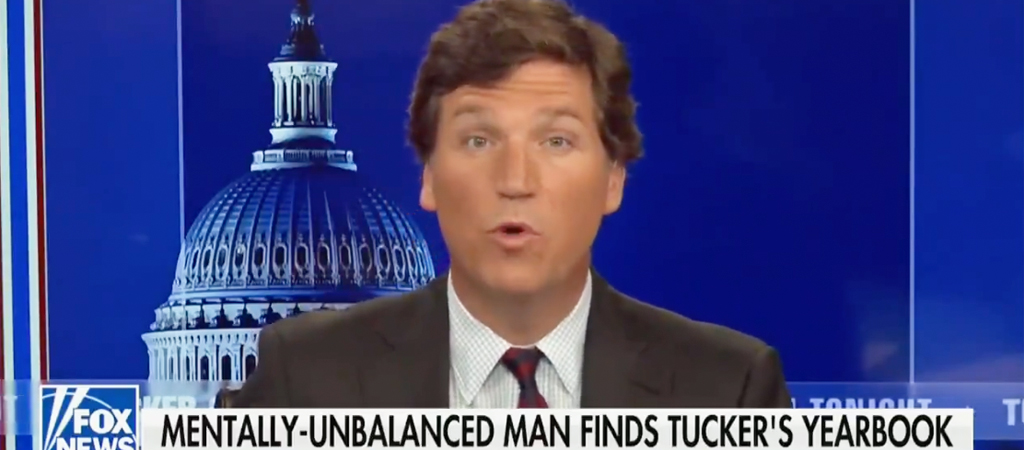
Tucker Carlson Sure Seemed Nervous About His College Yearbook Photo’s Discovery, And There’s A Good Reason Why

Tucker Carlson unleashed another Joker-hyena laugh on Wednesday night, but even he wasn’t laughing about the discovery of his yearbook photo. As seen below, Tucker even took a few moments to condemn “a mentally unbalanced, middle-aged man,” who he blasted as a “minion” of Amazon’s Jeff Bezos. He was talking about Washington Post media critic Erik Wemple, and Tucker appeared to feel terribly apprehensive about Wemple’s discovery (who Tucker said “called around to see if we did anything naughty at the age of 19″) of Tucker’s 1991 yearbook photo.

There’s a damn good reason why Tucker was nervous, and that’s because his college yearbook photo caption was damn bad. The caption identifies the bow-tie sporting future Fox News host as a member of the “Dan White Society,” which references the murderer of Harvey Milk, California’s first openly gay elected official (White also assassinated San Francisco Mayor George Moscone at City Hall). The caption also articulates Tucker’s allegiance with the “Jesse Helms Foundation,” which references the former ultra-conservative (and noted segregationist) senator from North Carolina.

The Wrap has confirmed the realness of Tucker’s college yearbook photo with a statement from a Trinity College spokesperson, who also pointed out that these clubs likely didn’t exist, meaning that Tucker had invented them for the caption:

A representative for Trinity College confirmed the veracity of the yearbook entry to TheWrap… The spokesperson pointed to a digitized version of the yearbook, which features the entry on page 186, and added that the so-called “society” didn’t seem to exist at the school and was only mentioned in Carlson’s entry. A review of the yearbook by TheWrap found no other mentions of a “Dan White Society.”

“While I cannot speak to the yearbook process in 1991, current practice is that only a student’s name, home state and/or country, and the student’s major are listed with their photos,” the Trinity College representative said when asked whether Carlson submitted the identifier himself.

Tucker probably thought this was a “clever” caption at the time, although he sure doesn’t seem pleased about its discovery these days.

Categories
News Trending Viral Worldwide

Maggie Rogers And My Morning Jacket Performed For National Geographic’s Earth Day Celebration

Today (April 22) is Earth Day, but National Geographic got the party started last night with Earth Day Eve 2021, a virtual concert featuring performances that were filmed mostly in picturesque outdoor locations. They secured a strong roster for the show, which included Angélique Kidjo, Aurora, José González, Maggie Rogers, My Morning Jacket, Rostam, Valerie June, Willie Nelson and Micah Nelson, Yo-Yo Ma, and Ziggy Marley.

Rogers took to Topanga Canyon, California for a rendition of “Love You For A Long Time,” while My Morning Jacket premiered a new video for “Feel You,” which was filmed in Los Angeles and Floyd’s Knobs, Indiana.

Alongside the performances, National Geographic also announced Planet Possible, “a new multiplatform, multiyear initiative aimed at helping consumers build on the scientific and environmental gains of the past year and empower them to live more lightly on the planet.” They also launched the Share Your Spot campaign, “an uplifting social media campaign that unifies National Geographic’s global community around a shared love of the Earth,” which “encourages users to share the places that bring them happiness, hope and optimism, by submitting pictures using the #ShareYourSpot hashtag.”

Check out the full event above. González’s performance starts at 14:27 into the video, My Morning Jacket starts at 34:58, Marley starts at 48:57, Rostam starts at 53:09, Nelson starts at 58:09, and Rogers starts at 1:01:31.

Categories
News Trending Viral Worldwide

Beyonce’s ‘Lemonade’ Turns Five: Fun Facts You May Not Know

Few can forget where they were when Beyoncé’s Lemonade dropped on Saturday, April 23, 2016. The double feature — part pseudo-surprise album, part star-studded visual project — found the notoriously private superstar letting fans in on details of her marriage to husband Jay-Z. Throughout the 45-minute, 12-track LP, listeners and viewers were taken on a journey of grief, anger, acceptance and reconciliation across the musical lens of R&B, pop, trap, rock, and country. (During the visual project, these emotions are verbalized by prose from Somali poet Warsan Shire and spoken by Beyoncé.) Through both mediums, we gain insight into Queen Bey’s experience with infidelity, and the overarching experiences of Black women in America, which includes feelings of unworthiness, frustration, and shame. However, Lemonade ultimately highlights Black women’s astounding resilience against all odds.

Given the shocking death of iconic artist Prince just days before its release, many credit Beyoncé for carrying the torch of the multitudinous musical behemoths who came before her, while praising the album as a sonic triumph. While no one could have predicted the pain that came with losing yet another legendary act, the welcome celebration of life, love, and damn good music provided by Bey’s sixth project truly turned our lemons into lemonade.

In the five years since its release, Lemonade spawned countless dissections, podcasts, and even college courses regarding its legacy and alignment with the Black feminist movement. And those infidelity claims Beyoncé makes during Lemonade? Jay-Z confirms them in his Grammy-nominated project, 4:44, released a year later. In 2017, Lemonade was nominated for nine Grammy Awards, controversially winning only two. Nevertheless, its impact continues to reign, and the Grammys eventually caught up to her greatness; in 2021, Beyoncé became the singer with the most Grammy wins in history (regardless of gender).

In honor of the album’s fifth anniversary tomorrow, we’re dropping five facts about the album and visuals that you may not have known prior. Take a look below at some tidbits, and give Lemonade a stream or two in honor of its monumental birthday.

The Well-Used Samples

As mentioned above, Beyoncé showcases her ability to traverse genre throughout Lemonade, and various musical influences can also be found within its samples. The bouncy, emotional ‘Hold Up’ samples pop star Andy Williams’ “Can’t Get Used to Losing You” from 1962. The Jack White-assisted “Don’t Hurt Yourself” borrows from Led Zeppelin’s “When The Levee Breaks.” The shadowy, trap-tinged “6 Inch” is a nod to soul icon Isaac Hayes’ “Walk On By” and interpolates psych band Animal Collective’s “My Girls.” And most notably, Outkast’s “SpottieOttieDopaliscious” is used in “All Night.” This is the second time within Beyoncé’s discography that she’s used this particular sample — the first was 2014’s “Flawless Remix” featuring Nicki Minaj.

“Songs Become Tweets, Tweets Become Songs…”

”Hold Up, they don’t love you like I love you,” Bey sings in the chorus of “Hold Up.” But did you know that this line in particular reworks a lyric from the Yeah Yeah Yeahs’ 2004 song “Maps”? (“Wait, they don’t love you like I love you,” Karen O says in the original song.) Even more interesting, the reworked Beyoncé lyric was originally a tweet written by Vampire Weekend’s Ezra Koenig in 2011.

Koenig, who wrote “Hold Up” along with Bey, Diplo, Emile Haynie, Father John Misty, MNEK, and MeLo-X, was paraphrasing the lyric from “Maps” when he wrote the tweet, which randomly popped into his head while recording. “I figured it was going to be a Vampire Weekend song but was easily convinced that it could be better/go to a new place as a Beyoncé song,” Koenig tweeted in 2016 after the release of Lemonade. “Songs become tweets, tweets become songs – it’s the way of the world.”

Getting In Formation In Coachella

Swae Lee of the rap duo Rae Sremmurd is credited as one of the co-writers on Lemonade’s first single “Formation,” which dropped out of thin air in February 2016. According to an interview with the song’s producer Mike Will Made It, Swae Lee came up with the chorus of “Formation” on the way to Coachella in 2014.

“So we’re in the middle of the desert,” Mike Will told The New Yorker in 2016. “And we’re just coming up — we just freestyle, you know? — and Swae Lee said, ‘O.K., ladies, now let’s get in formation.’ And we put it on the VoiceNote. Swae Lee’s got so many voice notes that he doesn’t even record, but I’m like, ‘Dog, we got to do that “get in formation” shit.’ That could be a hard song for the ladies. Some woman-empowerment shit.” The producer sent five or six songs to Beyoncé’s camp, including “Formation,” and during a party months later, she told him she liked that particular song.

“I told her what I was thinking about the woman empowerment, and she was like, ‘Yeah I kinda like that idea.’ And she just left it like that,” he continues. “[She] took this one little idea we came up with on the way to Coachella, put it in a pot, stirred it up, and came with this smash. She takes ideas and puts them with her own ideas, and makes this masterpiece. She’s all about collaborating. That’s what makes her Beyoncé. Being able to know what she wants.”

Generational Recipes

At the end of the Lemonade visual, Beyoncé appropriately shares a recipe for homemade lemonade.

“Take one pint of water, add half pound of sugar, the juice of eight lemons, the zest of half lemon. Pour the water from one jug, then to the other several times. Strain through a clean napkin.”

She adds prose regarding how her “alchemist” grandmother “spun gold out of this hard life” and “found healing where it did not live,” which of course just sounds like beautiful poetry. But this is the real recipe for homemade lemonade from her grandmother, Agnéz Deréon, that’s been shared through her family across generations. In 2020 during the height of the COVID-19 pandemic, the recipe began to go viral on social media. According to Spoon University’s taste test, “The zest gives the lemonade flavor a uniquely tart taste, which is somehow also very sweet at the same time from the half pound of sugar.”

Grammy History, Because…Of Course

After the release of Lemonade, Beyoncé garnered nine Grammy Award nominations in 2017, including Album, Song, and Record Of The Year. According to an interview with The Recording Academy’s Head of Awards Bill Freimuth, Bey made history with these nominations as the first artist to ever be nominated across four distinct genres in one year. “Hold Up” was up for Best Pop Solo Performance, “Don’t Hurt Yourself” was nominated for Best Rock Performance, “Freedom” was recognized in the Best Rap/Sung Performance category, and Lemonade itself won Best Urban Contemporary Album.

“You’ve had other artists in the past, say Michael Jackson maybe, who have been nominated in that many different fields, but not in the same year and on the same album,” Freimuth said. “This is a first timer for us and personally I think it’s appropriate and pretty cool.”

According to the Associated Press, Beyoncé submitted her country track “Daddy Lessons” for consideration in a country music category. However, the song was reportedly rejected by The Academy’s country music committee. In the same interview with Freimuth, he says he was unsure if “Daddy Lessons” was considered for a country music Grammy, “But if it had, evidently the committee said it didn’t belong there.” Nevertheless, country artists like Blake Shelton and Dierks Bentley praised the song against detractors, and an official remix of the song with The Chicks was performed at the 2016 CMAs.

Categories
News Trending Viral Worldwide

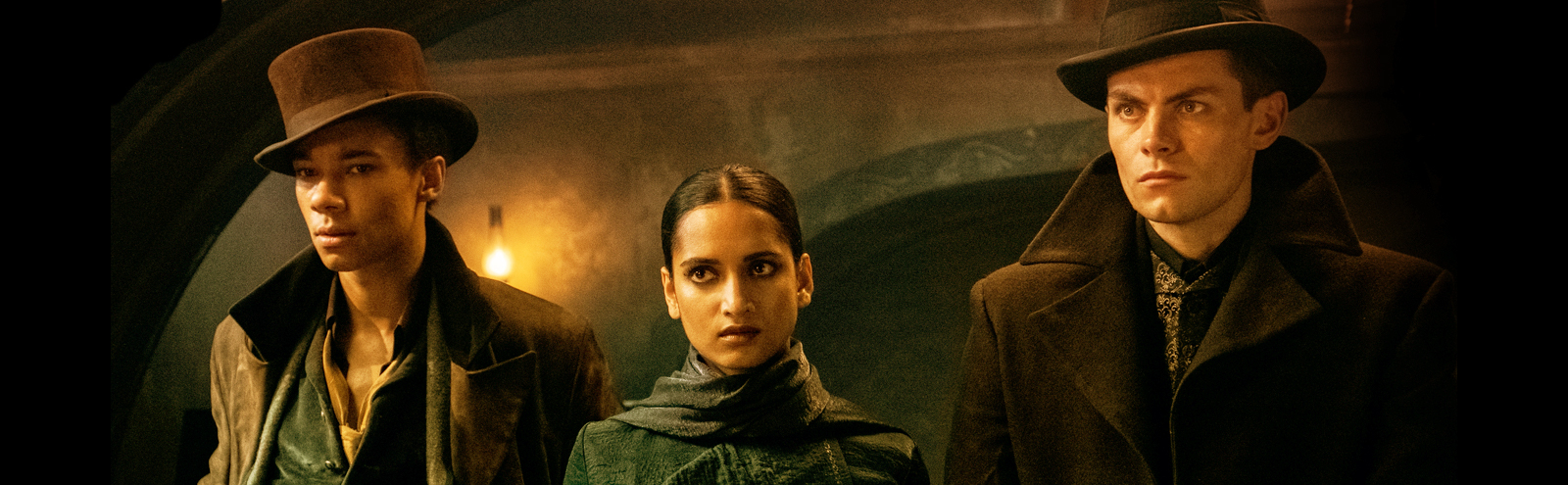
‘Shadow And Bone’ Showrunner Eric Heisserer On How Diversity Powered Some Of The Show’s Big Changes

Whether you’re a fan of Leigh Bardugo’s Shadow and Bone book series or you’re coming to Netflix’s fantasy adaptation as a Grishaverse novice, you’ll notice the show’s first season lays the groundwork for multiple worlds – and hopefully, spinoffs to come.

That was showrunner Eric Heisserer’s (Arrival, Bird Box) plan, anyway. He wanted to tell the story of a young orphan struggling to find her place in a time of war and learns she holds a power that could save her country. He also wanted to tell the story of a trio of thieves carrying a ton of personal baggage (and manage to pull off insane heists) in a steampunk fantasy world filled with magic and morally questionable characters. In the books, these worlds merely grazed each other. In Heisserer’s upcoming Netflix epic, they overlap and interact in fairly inventive ways.

We chatted with Heisserer about essentially writing a prequel novel when prepping for the show, how he approaches adapting other people’s work, and why it’s important to know which stories aren’t yours to tell.

It’s an interesting decision to merge Shadow and Bone with Six of Crows for this first season. Why did you decide to do that? More importantly, how do you pull that off?

Right. “How?” That’s a good question. I should have asked myself that before making the bombastic claim that it could work. I would say in part, [it’s] because [of] the way that Leigh has weaved into both of those sets of books these characters that cross-pollinate in their stories. It felt less like you could do one series and then consider a spin-off of the other. It felt more like they all lived in the same world anyway. And if we wanted to get into stories where you saw some of these people interact, later on, it felt much smarter to try and introduce them early. What I didn’t think about at the time was that I would have to come up with a prequel novel that would showcase the origins of these Crows, what they’re doing before we get to Six Of Crows, and how that would possibly cause some friction or interact with some of the Shadow and Bone storylines.

I’m guessing that means you were constantly calling Leigh Bardugo with questions?

[Laughs] We had the Grisha phone that we just picked up. We brought her in every week to the writer’s room where we’d pitch her more episodes. We’d just inundate her with questions that we’d have. A lot of the time, she of course had the answer because she’s been in this world in her head all this time. But now, and then she would go, “Hmm. Gosh, I don’t know if I’ve ventured in that spot. So impress me with something.” That would terrify half of my staff and excite the other half.

Creatives can be very protective of their work but a lot of times when you’re adapting something for the screen, changes have to be made. How do you, as the showrunner, approach that conversation?

Well, it started with me saying I wanted to do Six of Crows, the book story, as well as Shadow and Bone. And she just held up a hand and said, “I’m going to stop you right there. You really can’t introduce magic and then magic on steroids in the same season. You’re not going to get a sense of scale for your viewer. And it’s going to cause a bunch of problems.” And she’s absolutely right. So she was like, “What are you going to do now?” And I said, “What if we do a prequel?” And she’s like, “All right, I’m listening.” I had one idea that I knew, “Okay, this is either going to get me fired or we’re off to the races.” And, she loved it thankfully.

Was this your way of just ensuring that we get at least six more seasons of this universe?

I am! When I latch onto an adaptation, it is because I have more love for it at the time than my own harebrained ideas. I got into this business to write my own original stuff but now and then I come across something I love so much that I’m like, “All right, I’m going to do this.” That’s how I feel about her books. So really, what I’m doing is creating very expensive ads for her books.

When did the decision to change the heritage of the main character and make Alina half Shu happen?

It was one of the very first discussions that Leigh and I had, and it came from the lessons that she learned and what she took away as she grew as a fantasy author in her own right. To me, I saw that a core question within Alina is trying to figure out where she belongs. And that question thematically resonated for me in terms of, “I can tell that visually if we have someone who’s mixed race.” I had heard a story from a writer friend of mine who was mixed race and had that question burning in there for so long, feeling like neither family fully accepted her, and then trying to find her own identity. But beyond that, I really didn’t know the culture or the heritage side of things. I couldn’t speak to that. And nor should I. I can’t own those stories. So, my first hire was my mixed-race writer friend, who then can champion that in the room and share the experiences and imprint that on Alina so that we told her truth.

There are certain showrunners who like to have an iron grip on everything, and then there are showrunners who are able to step back and say, “Maybe this isn’t my story to tell.” Where do you fall?

Well, already I’m adapting somebody else’s work. I’m essentially just a steward of the Grishaverse. Something that I had said to Ted Chiang with Arrival, and I said it to Leigh, it’s like, “I am essentially borrowing the keys to your car, and it will have some aftermarket modifications. Please don’t be mad.” But maybe beyond that, I think that granted me the freedom to open up the playing field to people from many walks of life, and many disparate life experiences, be that racial or sexual identity, you name it. One of my writers was a refugee from Sarajevo. He and his family fled when he was a child, and that absolutely helped form some of the wartime feel of the show. It has absolutely become my job to provide a platform for these other writers to talk about these things. I don’t think of it as is my show. It is our show. This is not a singular voice kind of thing.

You’ve worked on bigger genre films like Arrival and Bird Box. What did you learn from those movies that you brought to this show?

It’s understanding that [I need] to give everybody, including our cast, who I think go above and beyond, support. To love them and encourage them in the right ways. And occasionally, give boundaries when we have to.

Speaking of future seasons, Netflix is notoriously secretive about viewing numbers and such. Have the powers that be given you a threshold to meet that gets you a season two pick-up?

Yeah. Every time they do that, there’s a buzz on the phone and I don’t get the number metrics. I don’t get to hear like, “What’s the threshold? What do I need to do here?” I’ve already called all my family members, my friend, my neighbors. What else can you do?

Netflix ‘Shadow and Bone’ premieres on April 23.

Categories
News Trending Viral Worldwide

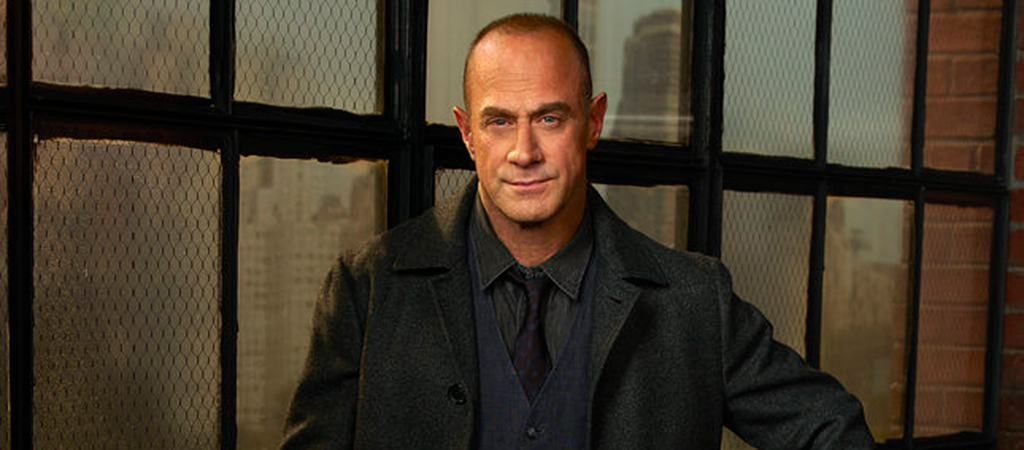
‘Law And Order: Organized Crime’ Is Having So Much Fun While Dragging Chris Meloni’s Cop With A Checkered Past

Earlier this month, Law and Order: SVU welcomed back the “prodigal son” (as he was actually referenced in an episode title), hot-headed cop Elliot Stabler, to the NYPD. The crossover event finally had Christopher Meloni in the same room(s) again with Mariska Hargitay’s Olivia Benson and Ice-T’s Fin Tutuola. Obviously, there’s a sentimental factor here. People loved Stabler’s camaraderie with Benson (who is now a captain), and he was absurdly beloved as a character (damn that Meloni charisma), but oh boy, it is hard to look back on Stabler’s behavior without feeling conflicted. And to be perfectly blunt, Elliot Stabler’s name feels ironic these days because he looks like the portrait of an unstable cop. With the launch of Meloni’s Organized Crime spinoff series, it’s interesting to see how the franchise is handling this cop with the checkered past.

Viewers will remember that Meloni’s 2011 departure from SVU all boiled down to a contractual dispute. Yet Stabler had grown notorious for using excessive force and pushing around witnesses and, most damningly, he shot six people in the line of duty. The final shooting occurred when a teenage girl brought a gun into the station house, and Stabler subsequently left the force. He did so abruptly and without even bidding farewell to Benson, who now believes (probably accurately) that he simply didn’t want to go through the counseling hoops. It was not a good look for Stabler, and he needs to do the work to make amends for Organized Crime to fully succeed.

How is the show doing so far? Surprisingly well, and it feels like an (intentional) work in progress. I did expect Stabler’s return to be more, well, awkward. Instead, Organized Crime feels enjoyable, mostly for the way that the show’s delighting in gently roasting Stabler. The dragging is happening, for sure, even though it’s happening slowly. It would be rather heartless for everyone to come down hard on him right after his wife got killed, which definitely happened in the crossover episode with the whodunnit aspect still unsolved. In the meantime, Stabler has not taken any time off work. It’s also revealed that he’s been an NYPD liaison in Rome for years, and suddenly, he’s sliding back into stateside duty and going up against an indisputably bad guy, towards whom it is perfectly acceptable to go toe-to-toe with while making angry faces.

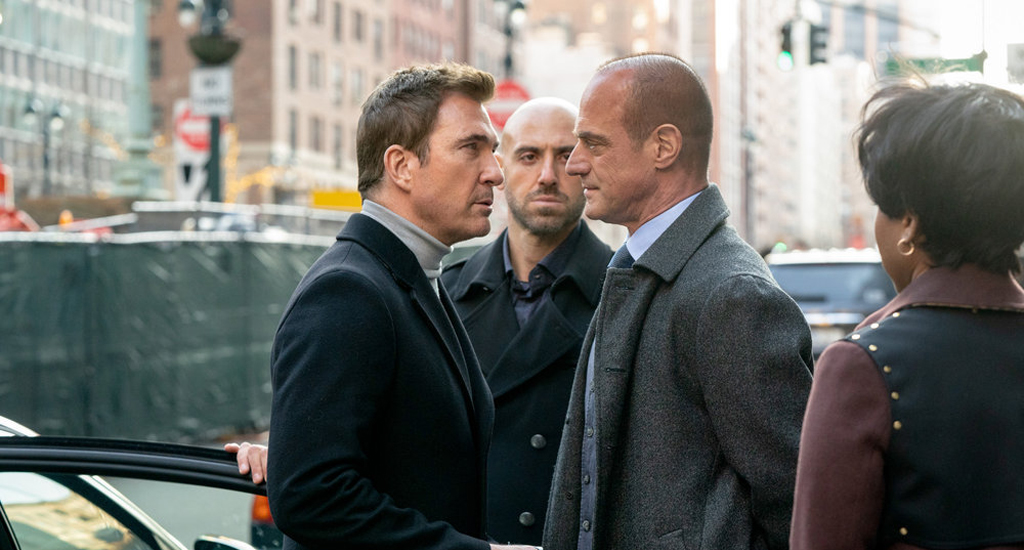
Dylan McDermott’s mafia-brat villain, Wheatley, wields a damn octopus as a weapon.

NBC

An octopus. As a weapon.

NBC

That’s pure evil, man. It’s wise for the show to position Stabler (at least from the start) against a guy who everyone knows is a baddie. There are no antihero shades, and no reason for anyone to feel sympathy (we’ve seen Wheatley have his own dad killed). When it comes to successive villains, though, we need to see Stabler have to strive for growth. We need to see him make the correct calls against someone who isn’t (to be blunt) a rich white guy. And we need to see Stabler abandon his intimidation tactics, too. He already messed up in the interrogation once since his return, and he promised Olivia that it wouldn’t happen again. So while we wait on that subject, let’s do a quick listing of the ways that Organized Crime isn’t letting Stabler get away with everything.

NBC

— Stabler’s new boss is Sergeant Ayanna Bell (Danielle Moné Truitt), and I feel so giddy to see those shots where he’s walking behind her confident self. She doesn’t take kindly to his attitude following her inquiry of his six on-the-job shootings. “All of them good!” Stabler popped off in defense, despite skipping town on the last one and easily scoring a good-old-boy return to the force. He grouses about how he doesn’t want to be judged for his behavior twelve years ago, and this dialogue is telling:

Stabler: “I was a damn good cop then. I’m a better cop now.”
Bell: “Guys who came up when you did, you guys never think you really need to change your ways.”
Stabler: “Really? You know you’re profiling me right now?”
Bell: “Detective Stabler, you don’t know a damn thing about being profiled.”

Boom. Stabler didn’t have a comeback, either. The humor isn’t entirely coming across in mere dialogue, but damn, this was the good stuff.

— Oh, I’m gonna talk about Stabler’s new boss again because this is the primary way (again, so far) that the show’s telling him to cool it. Sergeant Bell is not only a Black woman, but she’s also gay. They have a discussion on “demographics” (as Bell puts it), where she points out that as a gay Black woman, she would never be allowed to cross lines like Stabler did back in the day. She articulates that he’s got a higher pay grade than she does, even though she’s his boss, and Stabler doesn’t say much to this, other than that she’s “still the boss.” They seem to come to an unspoken agreement about the unfairness of the situation, and Stabler then wonders aloud if they are “partners,” and Bell calls them “equals.” I did laugh when she asked, “Do you know what it’s like being Black, female, and gay?” All he could say in response was this: “You know I do not.”

— Clearly, there’s a lot of inner wrestling happening with Olivia Benson and from Sergeant Bell, too. On Bell’s part, she tells her wife that even though Stabler is part of the old “gladiator” style of cops, she thinks he’s working on his demeanor. Whereas Olivia is truly worried about him. She frets over how he pounced at her witness during interrogation, and he was offended when Olivia called him out. “Don’t tell me that we don’t do it that way anymore please,” he chastised her. “I’ve been living in Europe, not under a rock.” Then he added, “Brave new world, I got it.” Yep, Organized Crime is not letting Stabler walk in, retooled and with a clean slate. He’s got work to do.

Currently, the show’s acting like Stabler will not be allowed shortcuts, but we’ll see how this season continues. We’re in a different TV cop landscape than we were a decade ago when Stabler departed. In the interim, showrunners have had to grapple with real-life civil unrest amid waves of tragic instances of police brutality — horrible behavior that has led to the cancellation of reality series including Live PD and the long-running Cops — and adapt accordingly. On one hand, Stabler’s return to the force signals the lingering power of the good-old-boys’ club in the TV portrayal of the NYPD. On the other hand, this is a chance for Law and Order to reform one of its most flawed characters.

‘Law and Order: Organized Crime’ airs new episodes on Thursday nights.