It makes sense that they have to put out a trailer, but Apple TV+ could have just said Jennifer Lawrence and Brian Tyree Henry are in a movie together, and that would have been all the sales pitch that Causeway needed. Since they have a trailer anyway, it showcases two quiet, stirring performances between the two powerhouses, working their way through difficult pasts that have kept them both from their ideal futures.
According to the official synopsis, Lawrence places “a military engineer who has returned to the States from Afghanistan with a debilitating brain injury after an IED explosion. It’s a painful and slow recovery as she relearns to walk and re-trains her memory, aided by a chatty but tender caretaker (Jayne Houdyshell). But when she returns home to New Orleans she has to face memories even more aching and formative than those she had in service: a reckoning with her childhood. Staying with her mother (Linda Emond), with whom she shares a tense relationship, all Lynsey wants to do is return to her work as an engineer. Her doctor (Stephen McKinley Henderson) is wary, and so in the meantime, she gets a job cleaning pools. When her truck breaks down she meets James Aucoin (Brian Tyree Henry), who works at the auto repair shop and offers her a ride home. Slowly they start to rely on each other for company and solace. James, it turns out, is also suppressing his own past trauma. These two damaged souls’ budding friendship forms the center and the heart of Neugebauer’s debut feature—a quiet but devastating, and ultimately uplifting, story about coming to terms and moving forward.”
Clearly, it’s not high concept. Probably not a single McGuffin in sight.
Causeway is the feature film debut of Lila Neugebauer, who directed episodes of Room 104 and The Sex Lives of College Girls. Well-received by critics, it hits Apple TV+ November 4th.
Sometimes, getting creatively frugal can make a wedding moment all the more special and unique. We’ve seen a growing trend of cost-effective, yet totally cool wedding ideas lately—from brides hitting up thrift stores instead of buying luxury items to couples taking engagement photos in completely unexpected locations. There’s an added thrill of being able to pull off romance and glamor without breaking the bank.
And thanks to the internet, by seeing others go viral for their budget-friendly choices, people might feel less pressure to spend tons of money on their big day. Because really, a celebration of two people coming together in love and partnership should be just that—not a financial obligation.
One bride has recently been wowing the internet with her DIY wedding dress, which she completely knitted and crocheted in just 45 days, and spent less than $300 on. Considering the average wedding dress costs around $1,800 … yeah, I’d say she saved big time. And the result was gorgeous.
Veronika Lindberg Heino, aka Kika, has been knitting since the age of 5. Her Instagram and YouTube channel are filled with tips, patterns and inspo, along with her book, “Knit This! 21 Gorgeous Everyday Knit Patterns.” Considering her prowess with needles and yarn, it might not be surprising that Kika immediately had the idea to create her own dress.
However, since Kika and her fiance wanted to double dip on the celebrations—they had only just moved into their new home and wanted to throw a housewarming party and wedding at the same time—she went back on the idea, thinking it might be too stressful.
Then, the more she tried to look online for a dress, the more it became clear that her initial instinct was the way to go. So she took a leap of faith.
“This might be the most crazy thing I will ever attempt to knit, and/or crochet … we’ll just have to see,” she can be heard saying in a 46-minute video chronicling her knitting journey from start to finish.
Fifty skeins of pure silk yarn were purchased, design sketches were drawn and tears of frustration were shed, but Kika succeeded in her mission. She met her wedding day with an absolutely stunning, handmade, truly one-of-a-kind dress that would turn heads.
Kika posted pictures on her Instagram, thanking her followers for showing support. Her caption read, “Every comment, dm and like has given me the energy to keep knitting all throughout moving homes and planning this wedding in only 1.5 months time, thank you ❤️.”
To say that folks were floored would be an understatement.
“This may in fact be the most beautiful wedding I have ever seen. Proves you don’t have to spend a fortune to have a beautiful, meaningful and enjoyable wedding day. Your dress is an absolute treasure,” one person commented on YouTube.
Granted, not everyone has been devoted to a craft since they were a wee toddler, like Kika. But still, a little resourcefulness often goes a long way. In my own experience, one of the most beautiful weddings I have ever seen was held beachside at a recreation center with all galaxy-themed decorations made by the bride. The whole day oozed of the bride and groom’s lovely personalities, rather than feeling like something out of a bridal magazine. Conversely, I was a caterer in my 20s and boy did I see a lot of dull, lifeless weddings that cost people’s entire life savings.
Most people want to look back on their wedding day and see themselves looking beautiful, surrounded by loved ones, having one of the best moments of their lives. There are so many ways to accomplish that feeling. Congrats to Kika on your wedding, your dress and, perhaps most of all, your happy day.
It’s wonderful to have a spouse who’s handy. Every homeowner knows that there’s always something that needs to be fixed or replaced. Having a handy spouse makes it a lot easier to get things done while saving the family a whole lot of money.
Laura Young took things a step further and is using her handy husband, James, to make the family more money.
South West News Service reports that she had a brilliant idea after listening to a podcast about a man who makes a living putting together ready-to-assemble furniture. Why not lend her husband out to other people to do odd jobs?
“He’s good at everything around the house and garden, so I thought why not put those skills to use and hire him out?” Laura told SWSN.
Laura made a Facebook post joking about her husband’s incredible skills as a handyman and, surprisingly, people started booking him for jobs. James booked so many gigs that he was able to drop his job working in a warehouse and gain greater flexibility to help Laura raise their three kids, two of which are autistic.
This was the beginning of a new business: Rent My Handy Husband.
u201cWoman who ‘rents husband to other women for u00a340’ says ‘business is booming’nnA mum-of-three who rents out her husband to other women for odd jobs is seeing her u00a340-a-time business boom, with the makeshift handyman working up to six days a week.u201d
James has been diagnosed with autism as well. “James doesn’t come from a trade background but his grandad was a nuclear engineer, and they think he was also on the spectrum,” Laura said. “He’s got a very methodical mind and can think outside the box. He sees things differently.”
James charges £40 ($45) an hour and is available to work in Milton Keynes, Leighton Buzzard and surrounding areas northwest of London, England. The couple gives price breaks to people who work for the National Health Service or who are 65 and older.
When James first started, he had so many bookings that he worked six days a week from 9 a.m. to 8 p.m. But since, the couple has cut down his schedule to a more manageable 9 a.m. to 5 p.m. Monday through Friday.
The couple works together as a team: Laura handles the booking and social media, and James does the manual labor. “You create and I’ll build,” James told her, according to the Rent My Handy Husband website.
James works to help anyone who needs help, whether its installing a trampoline, building a wall or putting up a television. The couple has also added a new specialty service for him this holiday season, putting up Christmas lights.
The couple’s decision to market James’ considerable DIY skills is a wonderful story about a family being resourceful. It also speaks to how families with special needs children require greater flexibility in their schedules to accommodate the extra work. Special needs children often have more doctor’s appointments and therapy sessions than typical children and may have to spend more time away from school. The hard part for parents is making it all work.
It’s wonderful that the couple could create a workaround for their lives and that they are supported by people in their community.
Jimmy Fallon recently asked folks to share a “funny or silly mistake” along with the hashtag #IfICouldTurnBackTime, in honor of what many consider to be the greatest mistake in all of human history—daylight saving time.
Since 1918, the chaos of DST has wreaked havoc across America—except in Arizona and Hawaii, that is—and the globe, causing us to spring forward, fall back, do the hokey pokey and shake ourselves about as we try to get a grasp on our schedules, energy and (seriously) overall health during that period of adjustment that comes twice a year.
Besides the topsy-turviness of it all, daylight saving time didn’t even fulfill its original purpose of saving electricity. In fact, a lot of evidence indicates that it actually costs more money. So yeah, it’s pretty much one of history’s biggest “oopsie-daisies.”
We might not be able to look back on DST and laugh just yet, but at least we can at least find comfort in the silly stories shared by strangers on Twitter.
Below are some of the funniest answers people sent to Fallon, ranging from “might induce a relatable chuckle” to “oh my, that’s delightfully cringey.” Even if daylight saving time doesn’t put a smile on your face, these mistakes might.
Without further ado, check out what other folks might have done differently if, like Cher once contemplated in her song, they could turn back time…
“I took my car to get fixed because the window wouldn’t roll up. I made it there just before it started raining. The shop had it fixed in two minutes. The window lock was on. They did not charge me, but it cost me some dignity that day.” – @AbbyTribble
“I would have CHECKED my mailbox to see the notice of suspended license due to unpaid tickets – before driving one night and getting pulled over & car towed. Having to pay just another $900 on top of what I already owed 🙃.” – @23Vaniece
“Grabbed a rebound from the opposing team free throw and threw up a beautiful fadeaway jump shot with nothing but net…Two points for the other team 🤦♂️” – @kenkaigle
“I would have checked the label on the sunblock I borrowed from a Cross Country teammate. Turns out it was muscle relaxer cream, and I started drooling halfway through the race since I applied it to my face.” – @Ashley_M_Lowry
“I am a middle school teacher, and when I was teaching the book Al Capone Does My Shirts, I had the title written in presentation. Unfortunately, I left the R out to shirts. I had written Al Capone Does My Sh!ts instead of shirts. I have never had a class laugh so hard! 👚💩🤦♀️” – @klennisd
#IfICouldTurnBackTime I would actually smile and try to look happy in my ID pic so that my family doctor wouldn’t make fun of me like it “looks like a mug shot”every time I come visit him 😐😅 pic.twitter.com/iOwW0v6imT
“Met my childhood crush @joeymcintyre of NKOTB. He commented on a pin I was wearing which sent me into a 5 minute monologue about Zazzle, how it works and why it’s my go to for customized gear. Then I walked away. Because I was… out of Zazzle content?!” – @NatteringNic
“When I was 5 I wiped cream cheese from my hand onto my dad’s brand new dodge shadow back seat. He caught me and yelled ‘come on use your head!!’ So I wiped the cream cheese on my head. 30 years later he still brings it up.” – @jbrad0618
“I would’t say ‘oh that must be mine’ while trying to grab from the hands of the guy who lives upstairs the package he was holding thinking he was the delivery guy. So embarrassing 🤦♀️😂” – @michi_says
#ificouldturnbacktime I would have taken a nap during a girls trip to Vegas and avoid getting this picture randomly sent all over my friends group just for laughs. pic.twitter.com/OCezsDwyKZ
“I went through the house turning back all the clocks on microwave, stove, living room wall clock…without knowing my husband had already done it. Needless to say we showed up for work 2 hours early on Sunday! 😴😵🤦” – @spiderbutt_68
“I did PA announcing in college and for an ad read, instead of reading the line ‘best breakfast,’ I said ‘breast breakfast’ in front of hundreds of people. Worst part was hearing the echo in the speakers mere seconds later!” – @Phanatic2010
“I would’ve made sure that the person walking behind me was in fact my mom before I turned back and said ‘I love you!’ to a random employee at Wal-Mart.” – @tubularcaracal
November is gearing up to be a busy month for Rihanna. Still on the heels of releasing her grand comeback single “Lift Me Up,” Rihanna has her Navy abuzz for a reported second song that is said to play in the credits of Black Panther: Wakanda Forever. In the same week as the premiere of Black Panther: Wakanda Forever, Rihanna is also set to debut her new collection of her signature Savage X Fenty line of underwear, lingerie, loungewear, and intimates in her annual Savage X Fenty fashion show.
As usual, fans can expect a grand event filled with actors, musicians, and other notable figures modeling Rih Rih’s latest fashions.
Who Will Appear As Models In Rihanna’s Savage X Fenty, Vol. 4 Show?
Among this year’s models are Black Panther: Wakanda Forever‘s Winston Duke, and Abbott Elementary‘s Sheryl Lee Ralph. Singer and TikTok influencer Bella Poarch, as well as YouTuber Rickey Thompson are also set to make appearances during the show. Zola actress Taylour Paige and Shang-Chi‘s Simu Liu will grace the runway, along with Snowfall‘s Damson Idris and Black-ish‘s Marsai Martin.
In a polarizing move, this year’s Savage X Fenty show will feature Johnny Depp, who will be the first man to have his own spotlight segment, as reported by TMZ.
Goose made their late night television debut yesterday. The band appeared on Jimmy Kimmel Live! to perform their song, “Hungersite,” off their recent album, Dripfield. The Connecticut-based jam band played for four minutes with each member of the five piece group giving their all — and the in-studio audience took notice. Still, fans in the comments noticed that this version was significantly shorter. (The original “Hungersite” runtime is about seven minutes.)
Outside of the television realm, Goose have played a significant amount of shows this year, including two dates at NYC’s Radio City Music Hall this summer.
“Clearly, the live thing is the main event at this point,” Rick Mitarotonda, Goose’s lead guitarist and songwriter, told Rolling Stone earlier this year. “But we love recording and want to keep exploring possibilities there. My hope is that, now, it’ll be a little bit more balanced. We have no intention of changing the fact that we are a live band, but we’d all love to to see the albums become something that they don’t typically become for jam bands.”
The band are set to join the Trey Anastasio Band on the road next week. The eight-show joint tour kicks off in Maine and will all be livestreamed. More information is available here.
Watch Goose’s performance of “Hungersite” on Jimmy Kimmel Live! above.
Irving and the Nets released a joint statement in which he said he took responsibility for the impact of his tweet, but the star still refused to issue an apology to the Jewish community, leading Adam Silver to criticize his statement and saying he will meet with Irving to discuss the situation. On Thursday, Irving again met with the media and was asked, point blank, if he had antisemitic beliefs, to which he refused to issue a direct answer. That was apparently the final straw for the Nets, as the team announced on Thursday night that Irving was being suspended for “at least five games” for continuing to refuse to “disavow antisemitism when given a clear opportunity,” and noting that he was “unfit to be associated with the Brooklyn Nets.”
The Nets note in the statement that they hoped to educate Irving on why his tweet was so harmful but to this point he has refused to engage in those conversations — most notably sending representatives to meet with the Anti-Defamation League rather than meeting with them himself. As such, Irving will now sit out games without pay until he meets “a series of objective remedial measures that address the harmful impact of his conduct.”
Lollapalooza has announced their next global festival expansion: Mumbai, India. In 2023, the music festival — which previously holds annual shows in Chicago, Argentina, Germany, Brazil, Chile, Sweden, and France — will be their first time hosting in Asia. The current lineup is stacked with Imagine Dragons and The Strokes as the two headliners taking the stage on January 28 and 29. According to Consequence, it is also the first time either headlining act has played a show in India.
Other acts on the first annual Mumbai bill include Greta Van Fleet, Diplo, Zhu, Chelsea Cutler, Japanese Breakfast, The Wombats, and many more. The festival will take place at Mahalaxmi Race Course.
Tickets for Lollapalooza India are currently on-sale now. The festival offers three tiers. VIP passes include access to elevated main stage viewing, exclusive dining options, and a special entrance line, per their website. Platinum ticket holders receive all VIP benefits, plus transportation between stages, preferred parking, air-conditioned bathrooms, front stage area access, and more special perks. General Admission passes are open to all ages. Children five or younger can attend for free.
However, one thing to note, is ticket delivery for international attendees. For buyers outside India, there will be no home delivery option for passes. The official website notes that only box office pickup will be available.
Check out the full line-up below.
Lollapalooza India
For more information on Lollapalooza India, visit here.
Some of the artists mentioned are Warner Music artists. Uproxx is an independent subsidiary of Warner Music Group.
On his third studio album, Luv 4 Rent, Smino collaborates with J. Cole on a smooth track called “90 Proof.” The song is a laid-back vibe, as Smino delivers his signature soulful, high-pitched vocal stylings on the song’s chorus.
“Take a break and roll the sticky, let’s get high / Not too great at relationships, at least I try / Patient, baby, gotta make a couple rounds / ‘Fore I make it back to you to settle down,” he sings.
In typical fashion, Cole swoops in with a fiery verse, with notable bars including, “‘Bout to go pull up on RiRi, and not for the feature, Ben Franklin note / You ain’t finna catch me in the type of places everybody go / I know exactly what my hands is for, to carry a lot of dough.”
Today, Smino and Cole have shared the song’s official visual. In the Phillip Youmans-directed cut, Smino and Cole are seen enjoying time with friends and family at a house party, vibing by an old-fashioned car, and playing an intense game of Uno.
In an interview with Complex, Smino revealed that “90 Proof” almost didn’t make the Luv 4 Rent tracklist, as Cole wanted the song for an album of his own.
“I never thought about being a songwriter, but he was like, ‘You keep yourself on the song, and I’ll be on it too. But I want to put it on my album,’” Smino said. “And I was like, ‘aigh.’ I thought about it and the whole time I knew it would be great for me, being on J. Cole’s album. When I was wrapping up the tracklist, though, I just felt like something was missing, and I put ’90 Proof’ right after my intro and it just sounded like they were meant for each other. So I just called Cole and asked him if I could get the song back and he let me.”
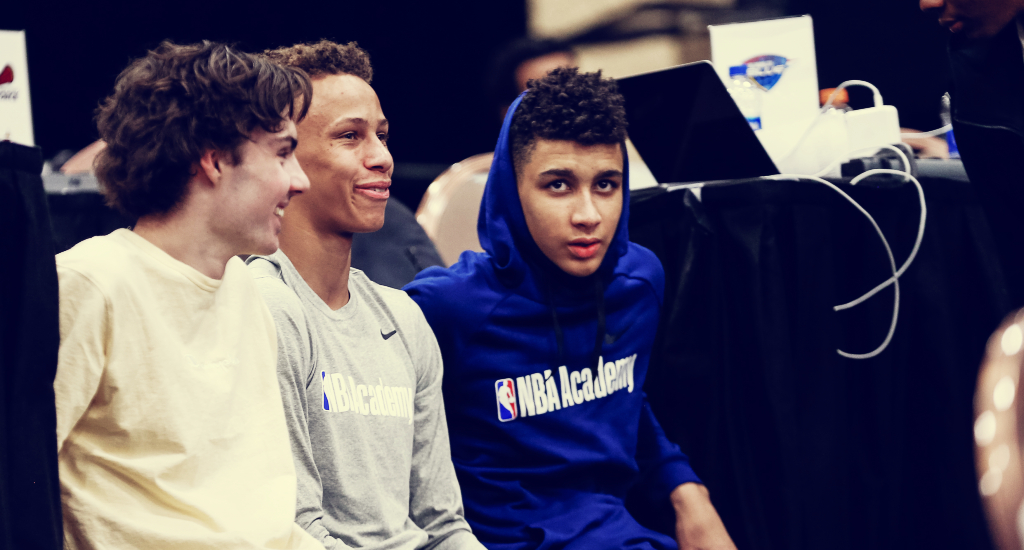
Marty Clarke knew the clock was ticking. A coach with a near-30 year career, Clarke’s had a hand shaping the games of every Australian player who has gone on to play in the NBA, and since 2017, in his role as Technical Director of the NBA’s Global Academy in Canberra, watched as Josh Giddey and Dyson Daniels accelerated their own plans to make the jump to pro.
Tyrese Proctor was going to be the same.
“In Australia, we have a talent I.D. system and then there’s a national championship system, and those things run in conjunction with each other but one doesn’t mean you’ll make the other,” Clarke explains over the phone early one morning from the Academy in Canberra, parrots screeching occasionally in the background. “It might be a young big doesn’t make a representative team, but we know he’s going to be good down the track. So we have a program where we can see those guys even though we don’t see them at national championship. So, Tyrese is not one of those.”
Given how small basketball is in Australia relative to the country’s more popular sports of cricket, football, and swimming, Clarke says it’s relatively easy to keep tabs on athletes and their progress. Moreover, that small scale has created a tight knit community of former players and coaches where word of mouth is often the first and best way to learn about potential players that would be a fit for the Academy. Given this, Proctor, even as a skinny 15-year-old, was someone Clarke and his team were “more than aware of.”
“People in Sydney were saying, ‘Oh, Rod Proctor’s kid is going to be really good.’ So we knew Rod — I’ve coached and played against Rod — so you sort of track everyone who’s a really good player and where their kids are at,” Clarke says, recalling Proctor playing in a National Sixteen Championship at 14. “We knew he was coming along the pathway and getting good. So then it was, do we leave him? Do we bring him in?”
With a limited number of total spots — 15 at the Global Academy in Canberra, 24 at NBA Academy Africa in Senegal, and between that range at the league’s other schools in India and Mexico — bringing someone into the Academy is no small undertaking. Staff at the academies meet with the athlete and their families, there’s an assessment of academics, of personality fit.
“We have to be very selective and be as sure as we can be before we extend an invite that it’s a right fit — both from our perspective and from theirs,” Chris Ebersole, Associate Vice President and Head of Elite Basketball at the NBA says.
Ebersole, who joined the NBA in 2013 as a coordinator for its international programs such as Basketball Without Borders, was tasked with identifying the gaps that came out of those programs. Very quickly, those gaps reached out to him directly. Athletes who’d gone through camps and, with access to the coaching and resources of the NBA, saw major improvements in just four days would send Ebersole messages on What’s App and Facebook, asking what was next, inspired to get themselves to the next level.
“That’s really how the concept of the Academy was born,” Ebesole says. “How do we take this BWB model that’s clearly working, we’re seeing the improvements even in these short spans, how do we take that and extend it to a full-time, almost year-round program? Especially for these young players who maybe don’t have access to the same coaching, same infrastructure, as kids in the states or Europe have. That was the lightbulb moment for us that went off in 2015, 2016, when we started kicking around the idea.”
It was a natural symbiotic fit to host the Global Academy, which Ebersole refers to as a “United Nations of Basketball”, within the Australian Institute of Sport. The 66-hectare headquarters has a long history and track record in basketball — Basketball Australia and its Centre of Excellence (CoE) program have been honing their programs there for 40 years, and the Institute has developed athletes holistically over a number of sports. Practically, it offered a CoE team for Academy athletes to scrimmage against, and it would also allow for the multi-prong approach the league wanted to take.
Beyond basketball, which includes strength and conditioning, formal practices twice per day, and nutrition, Ebersole underscores the importance of the off-court companion piece.
“We call it our Performance Lifestyle Curriculum and it’s life skills, mental skills, how they train, their mental wellbeing. It’s leadership, financial literacy, college readiness outside the classroom and off the court but also how they manage their time,” he says, stressing, “Our goal is the feedback we get from their coaches, or college coaches, is ‘Wow, these guys are so prepared.’ And that is the feedback we’ve gotten so far.”
Clarkson, having coached Giddey and Daniels up through that same system, knows a fit when he sees one — they brought Proctor in.
NBA Academy, Nicole Sweet
July in Jakarta. The Boomers went 6-0 and took gold for just the second time since Australia began playing in FIBA’s Asia Cup, but the second time in a row. The hard-nosed group on the floor, led by veteran Mitch McCarron, was disruptive and scrappy in games head coach Mike Kelly cheerfully referred to as dogfights, and popping up as a cool head in the thick of them was Proctor.
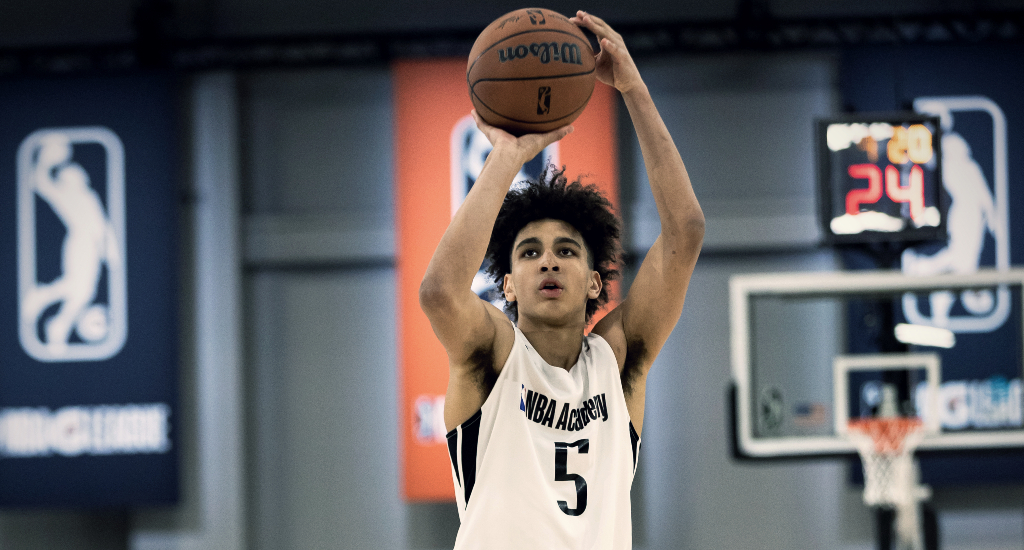
In a game against Indonesia that secured Australia its quarterfinals spot, Proctor dished unhurried from the wing, muscled in for offensive rebounds and second chance points, pulled up smoothly from a fast break for three, and otherwise looked composed, near leisurely. He was, on average, putting up the team’s second most points in the fifth most minutes, all while playing against opponents five years older.
“It was a big one for me. My first major Australian tournament. These are my first big minutes, and I had an impact on the game a bit more,” Proctor says over Zoom one morning, affably admitting he’s also just waking up.
The games were fast, he remembers, notably against Japan where he says he got burned three times. “I was like damn, these guys are quick. So I had to drop back a little bit. The pace was really quick. I haven’t really played pace, but physicality as well, to that extreme. So that was a bit of an eye opener, but I adjusted to it and really enjoyed it.”
Proctor is a versatile athlete. He played basketball, baseball, and soccer as a kid and, when he found himself naturally zeroing in on basketball in a way he described as “gravitational”, he stepped up his training with his dad, former Ole Miss and Australian hooper, Rod Proctor. Beyond his game, but something he recognizes as foundational in it, is the support he got from his parents. He remembers them taking time off to drive him all over Australia for tournaments, fostering his skills “as well as supporting me as a person,” he says. He also credits them with his level-head, his manners, and “just being a good person overall.”
A month before the Asia Cup, Proctor reclassified from Duke’s 2023 class to 2022 when Trevor Keels declared for the NBA Draft. Duke’s coach, Jon Scheyer, called Proctor and his family and presented the option for him to jump up a year. The roster spot with Australia’s national team was a crucial bridge in service to that acceleration.
The Boomers, and really Australian basketball, have hung their hats on defensive prowess and generally being unrelenting on the floor. Think of stalwart bigs like Andrew Bogut and Aron Baynes, lunchpail little-bit-of-everything guys like Joe Ingles, and punchy guards like Patty Mills and Matthew Dellavedova. As the youngest on the roster and second youngest in the tournament, Proctor was consistently up against bigger and stronger players but held his own defensively, happily noting he did a “heaps better job” thanks to guarding McCarron and Dellavedova at training camp. He looked, for all his 18 years, pretty complete.
That was the point.
“When the Boomers opportunity came up, it was like alright, let’s not worry about what he’s doing here, let’s make sure he can get onto that thing because he’s going to be around people that have travelled the path that he wants to travel. And they can help teach him,” Clarke remembers.
In Australian basketball, and especially for its youngest up-and-comers like Proctor, none of that is a euphemism. Clarke notes the alumni feel the Boomers have given that most all of the country’s players who’ve gone on to the pros have been on the team and come through the CoE, and says it’s as close to the U.S. college alumni system as they have in Australia. Older athletes are, in a sense, training up their replacements.
“It makes for a healthy culture, healthy environment. Most pro teams are not like that because you don’t want anyone to take your minutes, let alone your salary,” Clark says.
The foundation of that culture is borne out of a saying that kept coming up in conversations about the Global Academy, but more widely, Australian basketball: Iron sharpens iron.
“The way we, or I see it,” Proctor says, correcting himself though his choice of pronoun already gives a good hint, “is if you’re not woking hard and giving 100 percent, then your teammate’s not going to get that. So it’s sort of like a brotherhood. You don’t only respect yourself, but the people that you’re living with, and trying to see them do well. If everyone wasn’t working hard and doing their best, then the program wouldn’t be as successful as it has been and is.”
“If you go to a club environment you have a veteran or a group of veterans that can be leaders or can teach the next group down, can make sure practice runs smoothly,” Clarke elaborates. “Here, we don’t have that. Our veterans are 18, 19 year olds. So we have to keep instilling in them, if you’re not working hard, the guy that’s next to you is not getting the benefit out of it, so he can’t benefit you.”
The idea is that the harder a person works, the faster they learn, and the more it benefits the group. In an environment like the Academy, for Proctor, he may be asked to give it everything he has every time he shows up, but he gets that back multiplied by ten in any given practice. It also means coaches don’t grill and drill players on specifics or the number of reps they get down any given week, instead, accountability kicks in.
“That was a good thing,” Proctor recalls, “You can’t just sit back and pray your work’s going to get better, your game’s going to get better, you have to do it yourself — your basketball’s up to you.”
“It’s a constant thing we say in here,” Clarke smiles, “If the guy next to you is not pushing you, remind him.”
NBA Academy, Nicole Sweet
Clarke and the staff at the Global Academy had been looking for ways to push Proctor since he declared for Duke in April 2022, then in his third year of the program. When he first arrived in Canberra, at the threshold of the youngest athletes the Academy accepts and no longer being the biggest or strongest, Proctor sought out his own challenges, often pitting himself against the older Giddey and Daniels, both of whom he’d grow close to.
Every term, Proctor and other players met with Clarke to talk through what they wanted to do better on and off court. It was a way of ensuring each athlete, in guiding their goals, stayed accountable.
“It was called IDP — Individual Development Plans,” Proctor says, “The NBA guys would talk to Marty, and the CoE guys would talk to [Boomers head coach] Robbie McKinlay. We had a diary sort of thing, so you have this outline from different points in the diary, and you go off them, and then [Clarke] shares what he thinks you need to get better on just from watching. Over that next gap before your next meeting, you try to really hone in on those specifics.”
“I know that diaries and hand writing is kind of uncool these days,” Clarke chuckles. “But the diary is as much about writing down what you’ve done well as areas you need to improve on. I think in this environment it’s kind of a bit of a blend. There’s so much going on and it’s twice a day. Sometimes players forget what they’re actually good at.”
For Proctor that was “firstly, going in and getting stronger,” he says, then dialing in on specifics like finishing, getting his teammates open when attacking the lanes, and pick-and-rolls. Off-court training would follow suit, like watching a lot of film of Chris Paul coming off screens.
“It’s more about the players taking control of their own development, and taking time to decompress. They might’ve had a shitty practice, but let’s get it down on paper, let’s figure it out and solve this problem rather than going back to your room and dwelling on it,” Clarke notes.
The Academy programming, though individualized for each athlete, focuses on mental boosts in reality checks to help maintain a steady level of confidence and belief. There’s an inverting of the whole rookies carrying the bags tradition, which the Academy tends to give the responsibility of to its seniors, knowing younger players have enough going on in their heads as-is. Clarke also gave the example of the Academy’s first year players competing in local tournaments — “So you come in Monday to Friday and have the older guys beat you up, basically,” he chuckles, “and Friday night you can go to a local comp and rip out 50.”
Beyond accountability, keeping a diary helps young athletes slow things down.
Watching Proctor in his games during the Asia Cup, beyond his skill and versatility, the most striking trait is how patient and easy he is. Even the fraction of a second catch-and-shoots under pressure seem unhurried. It springs from a guard’s intuition, but beyond that is rooted in patience.
Asked if he considers himself a patient person and Proctor instantly breaks into sheepish grin.
“I’m definitely more patient on the court than off the court, especially in my mum’s eyes,” he laughs. “But I’ve definitely worked on that on court. Whether that’s coming off pick-and-rolls and playing as patient as I can, as calm as I can. I try not to get revved up or bogged down in being too slow, I try to play in a neutral mindset and play style, which has helped me over the last couple years.”
“Guys that played here have that same on-court demeanor as if they are veterans, because they’ve been put in that situation. We don’t have veterans, you have to assume that mantle both on and off the court so it makes you feel like the lead, and you are the veteran. It’s an ability to slow down, in a world that’s speeding up — everything’s speeding up, we’re trying to slow people down,” Clarke adds, of the way the diaries carry over to the court. “Because on the floor, everyone talks about you need to be fast, you actually need to be slow too. You gotta see what you’re looking for. If you play too quick, you can’t do that. That’s a good hallmark of all our guards, the ability to play slow, and then play quick. Not just quick to quicker.”
Where Proctor did wind up going from quick to quicker was in his development at the Academy. Coming in as a lanky 15-year-old who had always slugged it out against older players, he worked at his strength and game composure, and gained four years worth in just under three, even when a bout with Covid set him back the summer of his third year. When asked if it surprised him, that Proctor wanted to reclassify, Clarke barks out a laugh before the question finishes.
“I had been talking to his dad for maybe six months about, ‘We’re gonna need to find Tyrese something else to keep challenging him, to get the best out of him’ knowing his pathway was another year here,” Clarke recalls.
That path forked immediately when Keels was drafted by the Knicks and the call came from Duke.
“I guess we could’ve easily tried to talk him out of it on a selfish level, said no, we want to keep him,” Clarke shrugs, before turning sincere. “In the end it was pretty obvious that going and challenging himself, putting himself in a new environment, was probably going to be the best thing for Tyrese.”
Even if it was most exacting deja vu — Clarke could recall watching Daniel’s Draft with his Academy teammates, and Giddey’s the year before, all of them realizing these guys were supposed to be there with them — it was the right move.
“If you’re good enough, and you need to, you should move on. It’s the good part of the flexibility here,” Clarke nods, “Tyrese had really made that jump.”
While Proctor’s freshman season has yet to start, he’s taken to Duke for many of the same reasons he was drawn to the collegiate route in the first place. The sense of community, being close to his teammates, the campus, all elements that run parallel to the Global Academy and to the way he talks about his family (including his 14-year-old sister who also plays ball and he got to train with, and razz, before he left), who he’ll be the farthest away from he’s ever been. It was important for Proctor, too, to pick his own path, it just now happens that the last three top prospects who’ve left Australia all went through the Global Academy, and each via their own distinct routes.
It speaks to the versatility of the Global Academy, that as a program it has enough resources to give individualized attention to its athletes and prepares them for a life in the pros as well as off the court, or after it, all of which crystallizes in what mentors like Clarke try to instil.
“When this decision came up it was more about, why do you want to go? What do you think you’re going to get out of it? And what’s your response going to be if things don’t go as planned? Everyone talks about risk and reward,” Clarke says, “there’s actually a third part of that and it’s called recovery. If things don’t go well, how can I recover from it and how much time is it going to take?”
Proctor and Clarke spoke often about different outcomes he might see in his first year at Duke, like being number 10 in a new group and not getting to play. None of it was meant to throw Proctor off before he took his first step in a new direction, besides, Clarke says, Proctor is an adept problem-solver and communicator. This was Clarke giving Proctor advice to focus on the fundamentals he already knew — that the onus of his own development was on him, like it always had been.
“The big advice was once you’ve made this decision, don’t look back. And don’t ever forget this is your decision,” Clarke says matter-of-factly, an earnest smile on his face. “And if you own that decision, you’ll figure it out.”
This was iron, continuing to sharpen itself.
This website uses cookies to improve your experience. We'll assume you're ok with this, but you can opt-out if you wish. Cookie settingsACCEPT
Privacy & Cookies Policy
Privacy Overview
This website uses cookies to improve your experience while you navigate through the website. Out of these cookies, the cookies that are categorized as necessary are stored on your browser as they are essential for the working of basic functionalities of the website. We also use third-party cookies that help us analyze and understand how you use this website. These cookies will be stored in your browser only with your consent. You also have the option to opt-out of these cookies. But opting out of some of these cookies may have an effect on your browsing experience.
Necessary cookies are absolutely essential for the website to function properly. This category only includes cookies that ensures basic functionalities and security features of the website. These cookies do not store any personal information.
Any cookies that may not be particularly necessary for the website to function and is used specifically to collect user personal data via analytics, ads, other embedded contents are termed as non-necessary cookies. It is mandatory to procure user consent prior to running these cookies on your website.