Categories
News Trending Viral Worldwide

Kevin Durant Could Miss ‘Multiple Games’ Due To Contact Tracing Following Friday Night’s Fiasco

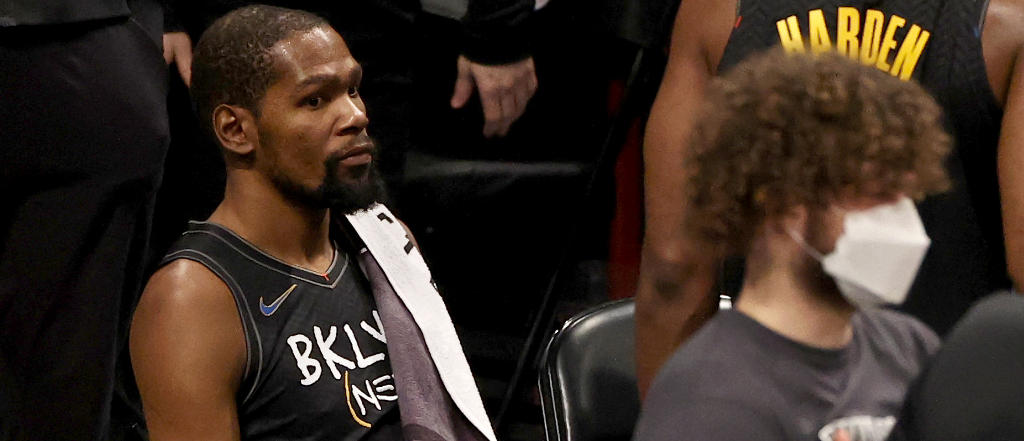
The NBA world’s collective eyes were on the Brooklyn Nets on Friday night, and not for a particularly flattering reason. Kevin Durant was unable to start the team’s 123-117 loss to the Toronto Raptors, and while he was eventually able to take the floor, during the game, Durant was told that he had to stop playing due to questions surrounding contact tracing, which were later revealed to be a member of his circle testing positive for COVID-19. The former NBA MVP was visibly upset about the incident, and after the game, he took to Twitter to vent some frustration about the entire situation.

Perhaps some of that frustration was explained by a report from ESPN that came out in the aftermath of the news. According to Malika Andrews and Adrian Wojnarowski, Durant will not only not be able to join the team in Philadelphia for its upcoming tilt against the 76ers, but he could end up missing a handful of games due to contact tracing for the second time this season.

After a confounding night surrounding the status of Brooklyn Nets star Kevin Durant at the Barclays Center — which included him getting pulled out of the lineup in the pregame and third quarter for contact-tracing protocols — Durant won’t travel to Philadelphia for Saturday’s game and could be lost for multiple games for the second time in a month, sources tell ESPN.

It is unclear when Durant could be able to get the green light from the league so he can return to action. The Nets standout has already dealt with the novel coronavirus, as he was among the first NBA players to receive positive tests that were made public back in March of 2020. Brooklyn has four games in the next week: Trips to Philly and Detroit on Saturday and Tuesday, respectively, before playing host to Indiana on Wednesday and a trip to take on the Warriors next Saturday.

Categories
News Trending Viral Worldwide

Evan Rachel Wood Has Shared More Details About Marilyn Manson, Accusing Him Of Anti-Semitism And Racism

Last week, allegations of abuse emerged about Marilyn Manson, starting with his former fiancée Evan Rachel Wood, followed by nine other women. Wood accused the singer of “grooming” her, starting when she was a teenager, and said she was “brainwashed and manipulated into submission.” Now Wood is going into further details, accusing him of various forms of bigotry.

The actress made her accusations on her Instagram stories. “I was called a ‘jew’ in a derogatory manner,” she wrote. “He would draw swastikas over my bedside table when he was mad at me.” She claimed he also gave her a hard time because her mother wasn’t born Jewish. “Because she converted and wasn’t of Jewish descent he would say things like, ‘that’s better’ because I wasn’t ‘blood Jewish.’”

And there’s more:

She also posted pictures of two tattoos he has that she says he received after their relationship began. One is an M-Swastika tattoo he has above his chest, which can be seen in many photos on the Manson Wiki, and the other is a skull and bones tattoo on his arm that she implies is a Nazi-era “Totenkopf” (“death’s head”) symbol.

“He did not have these tattoos when we started dating,” she added.

But allegedly Manson — whose stage name was in part inspired by noted cult leader Charles Manson — wasn’t just into anti-Semitism. “I heard the ‘n’ word over and over,” Wood added. “Everyone around him was expected to laugh and join in. If you did not or (god forbid) called him out, you were singled out and abused more. I have never been more scared in my life.”

Wood concluded by shooting down the offensive theory, floated by some, that theirs was simply a failed attempt at BDSM. “Brian and I never had a ‘BDSM’ relationship,” she said. “We didn’t even have ‘kinky’ sex. We weren’t having sexual intercourse when I was being tortured, before or after. I thought I was going to die the entire time.”

Among the other people who’ve shared hair-raising stories of Manson include Phoebe Bridgers and one of his earliest collaborators, Trent Reznor. Manson has denied all allegations.

(Via Consequence of Sound)

Categories
News Trending Viral Worldwide

‘WandaVision’ Viewers Celebrated The Return of Wanda’s Sokovian Accent

Warning: This post contains spoilers for the fifth and most recent episode of WandaVision. Tread lightly.

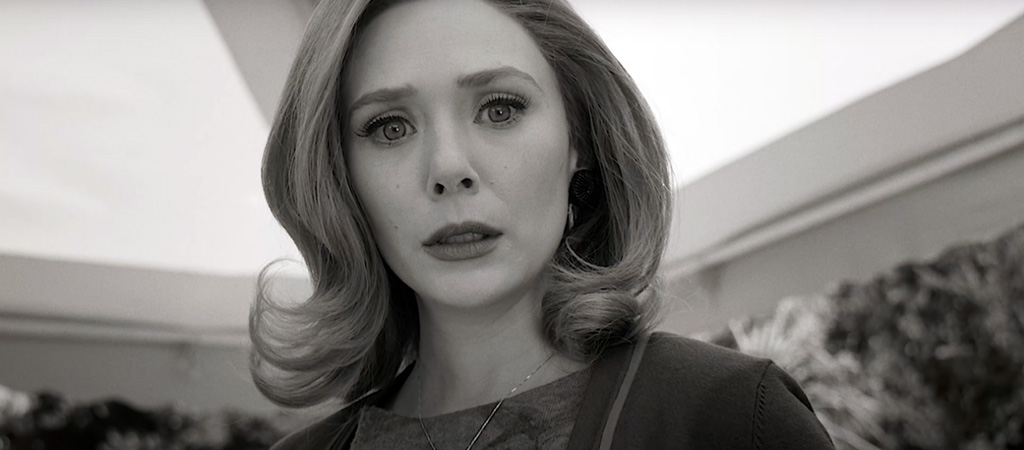
WandaVision, the MCU’s first Disney+ show, was a bit of a gamble, and it took four episodes for things to finally start to make some sense. But Marvel heads have been extraordinarily game, going along with a show that began as a parody of ’50s and has only gotten weirder and more ambitious from there. Their patience was rewarded with the fifth episode, widely considered the best one yet, and which delivered a few welcome surprises. Among them: the return of Wanda’s Sokovian accent.

The episode concluded with a stand-off between Elizabeth Olsen’s telekinetic Avenger and SWORD, the agency trying to figure out and stop Wanda’s alternate reality, populated by dozens of kidnapped people. So far Wanda has kept a bubbly American accent, but during her face-off, her old accent briefly slipped out. And people loved hearing it once again.

Wanda debuted the accent in Avengers: Age of Ultron, when she and Aaron Taylor-Johnson’s Pietro Maximoff — aka Quicksilver, though they weren’t legally allowed to call him that then — made their first full, non-bumper appearance in the MCU.

“The Sokovia accent was created by me and Aaron and our dialect coach because it’s a fake country and we could find different sources of Slavic sounds,” Olsen told Collider. “And we wanted to make sure it didn’t sound Russian because Black Widow speaks Russian, and so we just needed to sound more like Slovakian. So we created these sound changes that worked for Aaron’s British accent going to Slovakia basically and my American accent so that we sounded related.”

Now we have to wonder if Evan Peters, who played Quicksilver in Fox’s X-Men movies and who popped up at the end of WandaVision’s fifth episode, will suddenly start sounding Sokovian.

(Via ComicBook.com)

Categories
News Trending Viral Worldwide

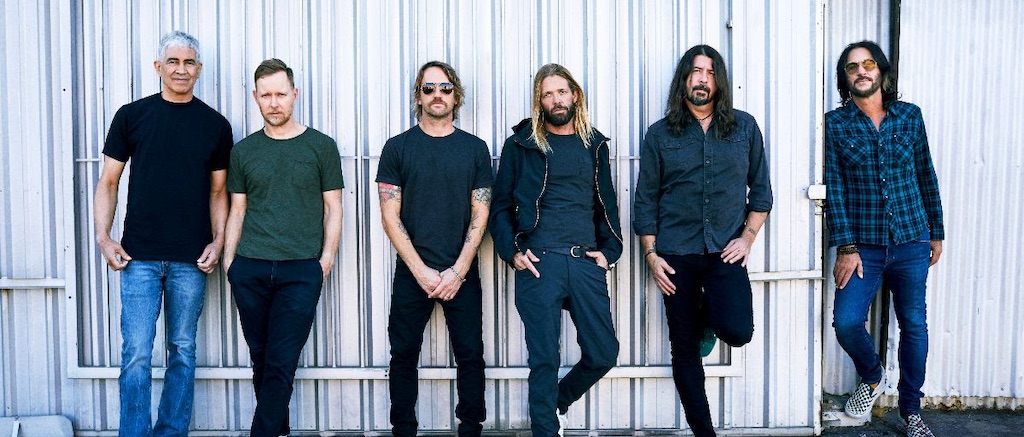
Foo Fighters Follow The Downfall Of An Intoxicated Man In Their Brash Video For ‘No Son Of Mine’

Foo Fighters just dropped their tenth album, Medicine At Midnight, which had been completed last year but had been delayed due to the pandemic. They’ve also dropped the video for “No Son Of Mine,” which follows the downward spiral of an intoxicated man. Following the heavy consumption of alcohol and different drugs, the man gets into a bar fight, a car crash, and more.

Upon the arrival of Medicine At Midnight, Foo Fighters member Taylor Hawkins had an interesting way of describing about what it felt like to finally release the long-delayed album. It was like “taking a big huge sh*t,” he said in a profile with Metro. “My stomach’s been hurting for a long time. Finally! A collective sigh of relief. We’ve finally got over our constipation.”

During an interview with EW before the album’s release, lead vocalist Dave Grohl talked about his own experiences making the album last year. “My favorite moment? It changes every year, honestly,” he said. “Doing SNL with Dave Chappelle a few months ago on the day they called the election, that might be my new one.”

You can watch the video for “No Son Of Mine” above.

Medicine At Midnight is out now via Roswell/RCA. Get it here.

Categories
News Trending Viral Worldwide

Continuity Is Fueling The Utah Jazz’s Strong Start To The 2020-21 Season

The value of continuity within a team can be overestimated, sometimes leading decision-makers to prioritize cohesiveness over a talent upgrade. For the Utah Jazz, though, the value of continuity has been on full display through the early months of the season. They own the NBA’s best record at 18-5, are second in net rating (plus-8.4), third in defensive rating, and fourth in offensive rating. They have notable wins over the Los Angeles Clippers, Milwaukee Bucks, and Denver Nuggets, as well as other playoff teams like the Portland Trail Blazers, Golden State Warriors, and San Antonio Spurs.

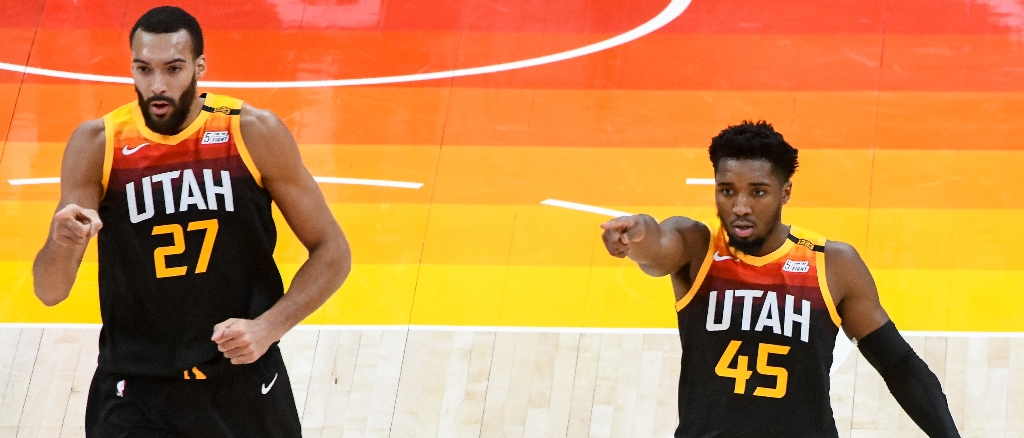
After a second consecutive first-round defeat last year, amid rumors of a incongruity between franchise pillars Donovan Mitchell and Rudy Gobert, Utah trusted its players and only made one significant change to the roster, bringing back longtime mainstay Derrick Favors following a one-year sabbatical in New Orleans. A shorter acclimation period, particularly during an odd year with an abbreviated training camp and offseason, allowed the Jazz to hit the ground running and distance themselves from the mid-tier playoff cluster they’ve often resided. They’re five games clear of the fourth-seeded Nuggets, while the Los Angeles Lakers and Clippers chase in pursuit of the top seed.

Quite frankly, Utah has been a buzzsaw so far, dissecting teams with precision, fluidity, and connectivity — 16 of its 18 wins are by double-digits. While top-end star power is an important factor in the idea of depth, the Jazz have arguably the deepest options 1-9 throughout the league, rostering nine viable rotation players, six of whom are averaging at least 10.2 points per game. Offensively, head coach Quin Snyder’s emphasis on movement, cutting, and multiple ball-handlers mask some of his team’s athletic and self-creation deficiencies.

Gobert’s space-carving screens and elite finishing pair suitably with the stable of ball-handlers around him. Utah maximizes those assets to spam ball screens, leading the league in pick-and-roll ball-handler frequency (22.8 percent of its plays) and ranking fourth in efficiency (0.991 points per possession), according to Synergy Sports. Individually, Gobert is in the 84th percentile as a roll man, while four different teammates — Bojan Bogdanovic (97th), Joe Ingles (94th), Jordan Clarkson (87th), and Mike Conley Jr. (81st) — rank in the 81st percentile or better as a ball-handler.

The term “screen assists” has reached a point of mockery for many people, but Gobert is legitimately a monstrous screener, the sort of roadblock that you can’t slip around but must entirely reroute past. He chisels wide driving lanes and defenders constantly spend far too long aiming to navigate around him. At any second, someone could audible into a lob. Defending bigs are cognizant of this, sometimes even abandoning rim protection duties to cover Gobert. All of this is a crucial component of Utah’s proficiency, amplifying the craft, skill, and touch from various offensive initiators.

Utah (25.4 percent frequency, ninth in PPP) and Gobert (72nd percentile) were similarly effective in the pick-and-roll last season. That output, however, isn’t the primary contributor to a rise from a ninth-ranked offense to a top-four unit. Rather, the Jazz are absolutely ripping it beyond the arc, increasing both volume and success rate. Their 3-point rate has spiked from .405 to .480, and they’re converting 40.7 percent of those attempts after shooting 38.4 percent in 2019-20.

Six of nine rotation players have a 3-point rate above .500 — Mitchell, at .451, is the lone non-center below .500. Clarkson (39.2 percent), Conley (41.0 percent), Mitchell (41.5 percent), Bogdanovic (42.5 percent), Ingles (44.1 percent), and Royce O’Neale (45.2 percent) are all shooting considerably higher than the NBA average of 35.8 percent from deep. They’re diverse in their long-range aptitude, too. Utah ranks second in pull-up three percentage (38.8) and attempts per game (15.1), fourth in catch-and-shoot three percentage (42.1), and seventh in attempts (26.5).

The final mark there is the biggest collective statistical differentiator compared to last season, when the Jazz were 23rd in catch-and-shoot three volume. Combine all that data, and Utah is second in three-point attempts per 100 possessions and second in percentage at 40.7 this season.

While predominantly a similar player to last year, Mitchell is another beneficiary of these efforts. He’s hoisting a career-high four catch-and-shoot threes per game and converting 50 percent of them, ninth among the 223 players taking at least two each night. He’s struggled at the rim — balancing interior passing and scoring remains a shortcoming — but his .451 3-point rate is another career-high, ensuring his true shooting percentage (56.9) is above NBA average (56.8) for the first time in four seasons. The surrounding personnel is warranting greater on-ball reps. Mitchell is sliding off the ball to spot up more frequently and he’s done so at an elite rate thus far, complementing the breakout performances of back-court partners.

Leaps from Conley and Clarkson have been to Utah’s two-way transformation. Conley struggled mightily through January last season, but discovered a rhythm over the final segment of the year, including the playoffs, which he has maintained to state his case as an All-Star. His .536 3-point rate is a career-high and he’s knocking down 38.6 percent of his pull-up threes on 30.4 percent frequency. The latter is a career high while the former is his second-best mark. He’s balancing intrepid passing and shrewd decision-making (2.91:1 assist-to-turnover ratio), and forms half of a spunky pick-and-roll tandem with Gobert. A defensive renaissance has helped fuel Utah’s climb from 13th to third in defensive rating, as he sheds screens seamlessly, shortcircuits drives, and flies around off the ball, denying or pilfering passes.

Clarkson, meanwhile, enjoyed a career campaign in 2019-20, both with Utah and Cleveland, and has elevated his play once again to emerge as the Sixth Man of the Year frontrunner. As the team’s lead reserve, he offers dynamic scoring pop and tenable, occasionally even menacing, on-ball defense, empowering him to slot into various lineup configurations. He’s en route to many career-highs, namely points (17.6), true shooting percentage (60.5, 3.7 percentage points above league average). and three-point percentage (39.2). Utah benefits significantly from his versatility. Netting 39.6 percent of his catch-and-shoot threes and 40.3 percent of his pull-up threes, he provides on- and off-ball floor-spacing.

Some of those catch-and-shoot possessions come off-movement, too, where he’s grown more adept. As a driver, he’s shooting 68.4 percent in the restricted area and 50 percent on shots inside the paint but outside the restricted area, touting a crafty finishing and intermediate game. Essentially, this season has witnessed his blossoming as a three-level scorer who functions comfortably in various roles. The Jazz have enough passing to surround him with a floor general (Ingles or Conley, most regularly), which lets Clarkson center in on his scoring chops.

Utah’s offensive attack is largely contingent on offensive malleability and good screening. There are an assortment of Jazz players who can pass, dribble, shoot, and work on and off the ball. They have two of the league’s best screeners in Gobert and Favors, who manufacture separation and high-value shots for perimeter guys, and other big-ish wings like Ingles, Bogdanovic, and O’Neale to scheme ghost screens or other sets that feature their shooting prowess. Upping the team-wide 3-point rate while Conley and Clarkson produce at levels previously unforeseen in Utah has facilitated an evolution to approach elite offense status.

Returning to their pre-2019-20 ways, when they regularly fielded a top-three defense, has been about improvement around Gobert instead of some sizeable leap from the Frenchman. Conley, as previously mentioned, is playing his most impactful and pestering defense in years, funneling ball-handlers into Gobert’s paws. Allocated the fewest minutes of his career (16.6) to help maximize his opportunities as he endures some athletic decline, Favors represents an upgrade at back-up center. O’Neale remains one of the NBA’s best and most versatile on-ball defenders.

The Jazz rarely commit shooting fouls, ranking second in opponent free-throw rate (.198). They rank first in opponent effective field goal percentage (50.1), eliciting difficult shot after difficult shot because of Gobert’s wide-ranging shot alteration domain, with help from guys like Conley and O’Neale. The Conley-Gobert and O’Neale-Gobert pick-and-roll defensive duos are elite, and Favors supplements the three-time All-NBA center well. Utah digs, stunts, and helps properly. Ball-screens often play out as they dictate rather than offense maneuvering as it wishes.

Merely referencing O’Neale’s services does not do his contributions justice. He’s a high-level starter on a very good team. He’s shooting 45.2 percent from deep (.705 3-point rate); defends a litany of positions with strength, lateral quickness, and efficient screen circumvention; and can attack closeouts to finish inside or whirl a pass against scattered defenses. Both Estimated Plus-Minus and RAPTOR place him among the top-70 this season, an apt summation of the scope of impact his shooting, play linking, and versatile defense fashion.

Last week, in a 116-104 victory over the Dallas Mavericks, the Jazz missed Favors and Mitchell, which thrust Miye Oni and Juwan Morgan into the rotation that day. Early in the second quarter, as Utah led 40-27, an important two-way sequence unfolded. Oni avoided an off-ball screen and coordinated a switch with Morgan for the on-ball screen. Tim Hardaway Jr. scooted past Morgan, but there was Georges Niang to slide over and contest the shot. A miss launched the Jazz into action, ball movement and decisiveness aplenty, yielding to an open Clarkson corner three.

There have been many impressive plays reflective of Utah’s success this season, but that one resonated. Three guys outside of the team’s top-8 in minutes per game executed on a string to spark the stop. Early offense where the ball pinged from teammate to teammate occurred. A 16-point edge existed fewer than 2.5 minutes into the second quarter, despite the absence of an All-Star and key rotation big man. Connectivity was the driving force.

This squad is intertwined and talented, overwhelming opponents on either end and justifying an affinity for continuity. Those two Los Angeles teams might prove too athletic and talented this summer, but Utah has made clear if anyone should challenge them, it will be the Jazz.

Categories
News Trending Viral Worldwide

NBPA President Chris Paul Responded To LeBron James And Other Players Gripes About The 2021 All-Star Game

The NBA is suddenly dealing with a player revolt over the 2021 All-Star Game. Guys like LeBron James, Giannis Antetokounmpo, and De’Aaron Fox have all spoken out against the idea, with Fox calling the whole thing “stupid” and the pair of former MVPs expressing their frustration over not getting a week to rest in March amid the grind that is this season.

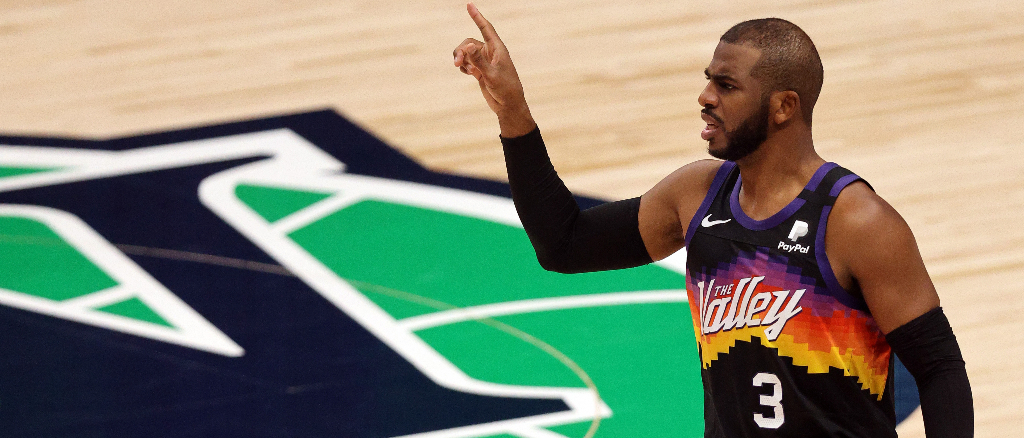
One person who had remained quiet on this front was Chris Paul, who in addition to his Point God-ery with the Phoenix Suns serves as the president of the NBA Players Association. Paul was asked about all of this on Friday night following Phoenix’s 109-92 win over the Detroit Pistons, he addressed the recent comments by his NBA brethren.

“Guys are entitled to their feelings, decisions, and everything,” Paul said. “I think the job for the union has been to try to make sure our players are healthy and safe. This is something that was a decision by the league, and we are definitely, day in and day out, trying to figure it out. We’ve got 450 players that we’re always trying to get insight from, and it’s tough. We’re all trying to figure it out right now.”

Paul was then asked about the conversations he’s had with other players, which he pointed out included recent talks with James and Steph Curry, and explained that he wants to “overcommunicate” things.

“There’s different situations, guys who’ve been playing a lot of games who haven’t really had much of a break,” Paul said. “I’m sure I’m not the only guy in the league that lives without their family, and so guys look at that break as an opportunity to see their families. It’s a lot of different things going on right now, but you just hope that guys understand that decisions that are being made — especially as far as the union — has always got the full body of players in mind.”

The NBA All-Star Game is scheduled to take place on March 7 in Atlanta. There is no word on whether Paul and the NBPA will push back on any aspect of the game in an attempt to acquiesce the players who do not seem particularly keen on attending.

Categories
News Trending Viral Worldwide

Diddy Filed A $25 Million Lawsuit Against Sean John For Using His Name Without Consent

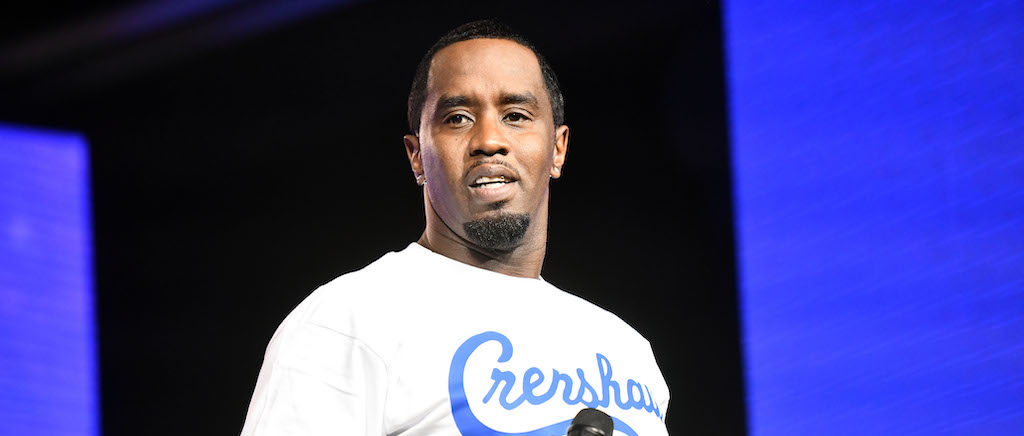
For the second time in as many months, Diddy has filed a lawsuit against Sean John. According to AllHipHop, the hip-hop mogul sued the brand and its owner, Global Brands Group, for $25 million after he claims they falsely attributed a quote to him while promoting an upcoming line with women’s clothing retailer Missguided. The publication reports that the lawsuit also accuses Sean John of using Diddy’s image, likeness, and persona without his consent for the new line.

Sean John was created and launched by Diddy in 1998. He continued to own the brand before he sold it to GBG in 2016. In the lawsuit, he says at no point did he endorse the upcoming collaboration between Sean John and Missguided.

“[Diddy] does not challenge [Sean John/GBG’s] right to use the Sean John trademark,” his lawyer Johnathan D. Davis said. “But rather [Sean John/GBG’s] decision to leverage a fabricated quote they created and then falsely attributed to Mr. Combs, and to use Mr. Combs’s name and other monikers to create the false and misleading impression that Mr. Combs is the decision-maker behind the designs and creation of the GBG Collection.”

Davis added, “[Sean John, GBG and Missguided] are using the Unapproved Material, which contains false or misleading representations of fact, to promote and sell the items in the GBG Collection because they understand that associating it with Mr. Combs will significantly increase sales and profits.”

The new lawsuit comes after Diddy sued Sean John last month over the trademark for the phrase “Vote Or Die,” which he created with his e non-profit Citizens Change. He claims Sean John and GBG illegally used and trademarked it while selling merchandise with it during last year’s presidential campaign.

(via AllHipHop)

Categories
News Trending Viral Worldwide

CBS NFL Analysts Lean On Their Super Bowl Experience To Break Down Bucs-Chiefs

Super Bowl LV will pit the reigning champion Kansas City Chiefs against the Buccaneers in their home stadium in Tampa, with kickoff scheduled for 6:30 p.m. ET. CBS’ coverage of the game will begin at 11:30 a.m. ET as they go wall-to-wall with That Other Pregame Show and The Super Bowl Today right up until kick.

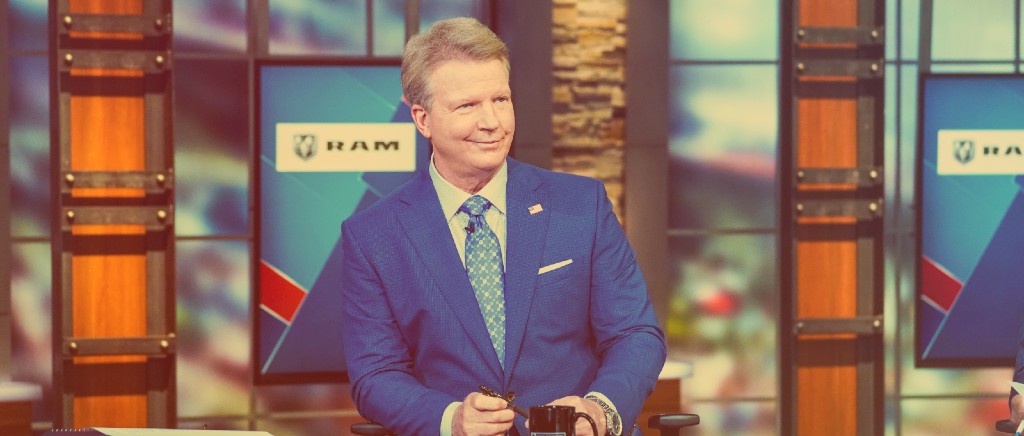
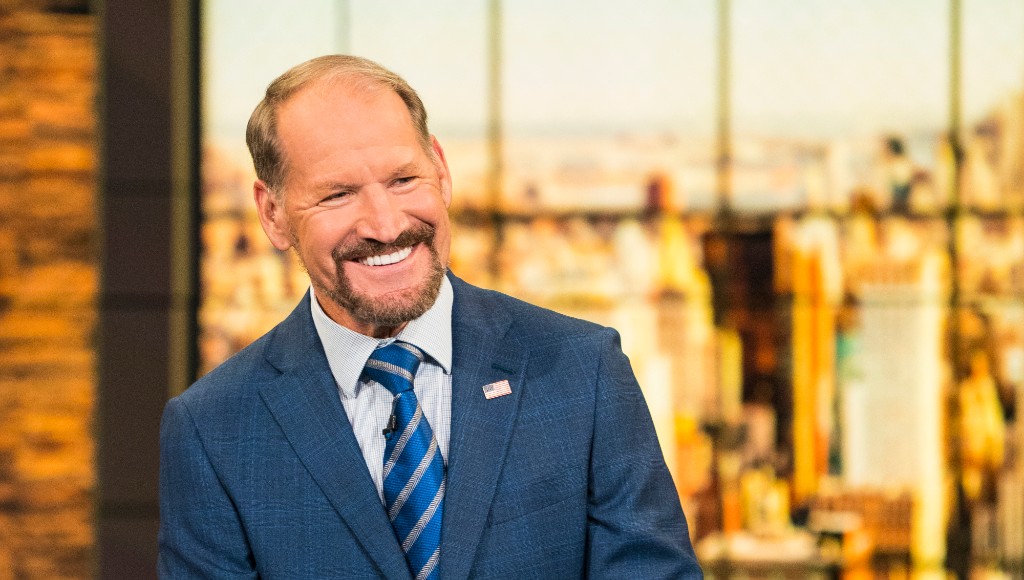
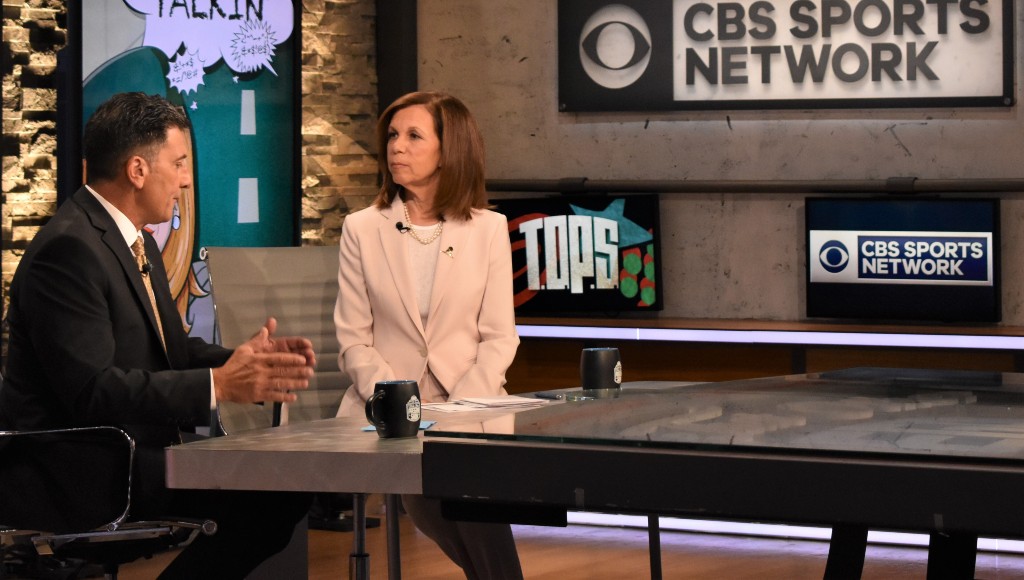
Over the course of seven hours of pregame coverage, they’ll try to dive into every possible angle on what we’ll see in the game that night. The five members of the CBS crew with Super Bowl experience will lean on that to guide their discussion. Bill Cowher, Phil Simms, London Fletcher, Amy Trask, and Gene Steratore give CBS a view into the Super Bowl experience from just about every viewpoint, with players who have won a Super Bowl on offense and defense, a coach who won and lost one, a former Super Bowl executive, and a former Super Bowl referee.

Over the past week, Uproxx Sports has gotten the chance to talk with those five about those experiences, with each sharing a favorite Super Bowl memory and how they plan to use that to guide how they will look at Chiefs-Bucs on Sunday.

Simms and Fletcher both can’t help but look at the defenses as the key in this one, as each offense is packed with talent — Simms noted they’re effectively All-Star teams at the quarterback and skill positions. Simms wants to see which team can dictate their style of play.

“Tampa Bay, they are a power team on both sides of the ball,” Simms says. “They can play that way and they have tremendous size. You know, we always just talk about the skill, but sooner or later it comes down to power, too, and Tampa Bay’s offensive line is powerful, I think their defensive line’s powerful. Now, when I look at Kansas City, it’s different. Offense, man, it’s movement, it’s everything to disguise and help their offensive line out, but they do have power on the defensive side. They have great size, and they have a tremendous coach. And, you know, they’re so aggressive. That used to be bad, but by the time last year about midway through the season, their aggressive defense became part of who they were and these cover guys got better. And look, they would not have won last year’s Super Bowl, I don’t think, if they didn’t have Steve Spagnuolo as a defensive coordinator.”

Fletcher expects the Chiefs to look to make Tom Brady work the ball down the field through the air, being aggressive in looking to take away the run so the Bucs can’t chew clock and keep Patrick Mahomes on the sidelines, while also being keenly aware of the Bucs’ big play threat as well. When it’s the Bucs’ turn to play defense, he anticipates Todd Bowles to dial it up with pressure to try and keep Mahomes from extending plays while leaning on Devin White’s speed to chase down the underneath stuff.

“Because the Chiefs are such an explosive offense, if you’re going to allow Patrick Mahomes to have time to get outside the pocket to create plays — which he’s as good as anybody in the league at — when he gets outside the pocket and buys time it’s hard for a defense or for a defender to cover a Tyreek Hill or Travis Kelce, or some of the other playmakers four and five and six seconds,” Fletcher says. “And when you look at the Tampa Bay Buccaneers, they love to bring pressure, I don’t think they’re gonna vary much from what they’ve done in the past in terms of blitzing and trying to get pressure on the quarterback. The Chiefs are going to be without their starting left tackle, so I’m sure they’ll try to scheme a way to take advantage of that. So going into the game, I believe that Todd Bowles is gonna dial up pressure and he may dial it up even more than he has in the past.”

Mary Kouw/CBS ©2019 CBS Broadcasting, Inc

From a coaching perspective, what stands out to Bill Cowher is the way these coaching staffs have adapted to their personnel and maximized the talent they have on both sides of the ball to shape their identities. That aggression from Kansas City’s defense takes advantage of their speed, while the Bucs are built to dominate in the front seven, and Bowles has leaned on that group to do damage and set the tone.

Offensively, Byron Leftwich and Bruce Arians needed to adapt this season to Brady, who wants to throw underneath more than Jameis Winston did, and they’ve found the balance between that and the deep passes they love to their dynamic pass catchers. On the other side, Eric Bieniemy and Andy Reid have embraced their generational quarterback’s gifts, and allowed Mahomes the freedom to explore his abilities fully while also understanding how to balance their big play ability with dominating possession, something that is easier with an all-everything tight end in Kelce.

With those two offenses being as talented as they are, Cowher expects a pair of factors to decide this game.

“I love that mantra that they’re both going to have went into this,” Cowher says. “It’s going to be move, counter move. Shot, take a shot, and can you respond. And so I always think it comes down to games like this, certainly the turnovers, we always talk about that, but to me, who can finish drives. I just go back and just look at the last few games. Tampa Bay, they stopped Kansas City in the red zone three different times. They were 0-for-3 in red zone. They stopped Aaron Rodgers three times and made them kick a field goal or at least make that decision and kick the field. So defenses are gonna give, they’re gonna take. But the ability to finish drives, the ability to hold people to field goals, to me is the most interesting.”

On the field, Trask is most interested to see how the Chiefs handle the excellent pass rush of the Bucs without starting left tackle Eric Fischer. Off of it, the former Raiders executive took stock of how these front offices assembled championship rosters. She notes how the two teams are constructed from the top down, with the great talent on the field that has sacrificed at times for the greater good — Mahomes, for example, made sure that the Chiefs also got an extension done with All-Pro defensive lineman Chris Jones last offseason as they were working on a deal with him, too.

She also, like Cowher, highlighted the coaching staffs and how they’ve pulled all of it together to create two teams with unique identities, but both following the key tenants of successful team-building.

“Look, the word ‘team’ is significant,” Trask says. “And you need to have a team that is more than an accumulation of individuals. Yes, it absolutely matters who is on the field and who is on that roster. But what we see with both of these teams is tremendous coaching. And what I think the best coaches do is they best position their players to be their best.

“So it is the job of the front office to bring in good players,” Trask continues. “And it is the job of the front office to also bring in the best coaching staff they can. And I believe the four most important words, not only with respect to a football team, and not only with respect to winning and building the environment you referenced, but all businesses are communicate, cooperate, collaborate, and coordinate. And if you are not as an organization, from top to bottom and throughout the organization, communicating, cooperating, collaborating, and coordinating, you’re not going to be your best.”

Mary Kouw/CBS ©2019 CBS Broadcasting, Inc

From a refereeing perspective, the task for Carl Cheffers and his crew is going to be very different depending on which offense is on the field. As Steratore explained, the points of emphasis and things the officials have to be paying attention to are very different because of the two different offensive styles, but he expects there to be a lot of work and pressure on the downfield officials.

“Brady is a very traditional pocket type quarterback, he very rarely goes outside of the pocket,” Steratore says. “So illegal contact and the fouls that pertain to the quarterback being in the pocket apply more there. Where Patrick Mahomes, with an RPO, which shows you run, it’s pass, he scrambles, is he in the pocket is he not, and that’s just breaking down, you know, the passing game a little. For officials that are working the receivers that you go through that step process, then to look back to make sure he is in the pocket and the ball is not gone, or it’s not a run. So many of those things, and then in this game, we have tight ends on both sides of the ball that can really do amazing things. And when tight ends can pressure and push the middle of the field, and with the speed that they both have on the outsides, the three officials that are downfield, that’ll work the majority of the deeper routes, they’ll be pressed into different types of coverages all day.”

Categories
News Trending Viral Worldwide

Greg Kurstin Opens Up About Producing Foo Fighters’ Album ‘Medicine At Midnight’

Foo Fighters finally released their tenth album, Medicine At Midnight, his past Friday. The album faced a lengthy delay as a result of the coronavirus pandemic, and in a recent interview with Variety, Greg Kurstin, who co-produced it, spoke about the lengthy road to completion.

“We got to really experiment with all these weird locations in the house,” Kurstin said regarding the property the band rented in San Fernando Valley to record it. “We’d set up the drums in the living room or, for “Shame Shame,” in the stairwell in like a three-foot-by-three-foot space.” He added, “You’d arrive at the house and some people would be hanging outside. We had a kitchen there. It was really fun to have this relaxed environment.”

He also discussed the band’s evolution since their last album, 2017’s Concrete And Gold.

I feel like we’ve gotten to some different territory on this album. In my experience from the last one, Dave would bring in a guitar riff and that would be the seed of a song; we develop it from that. But this one was coming from the drums a lot. Like “Shame Shame” started as a drum groove. Dave would say, “I want to do something like this,” and he’d drum on his legs with his hands, or sort of sing the beat. Then he would develop that into this amazing song. It was really cool to see that evolution[…] There’s almost a dance element to some of the beats, that feels very different from previous albums.

Medicine At Midnight is out now via Roswell/RCA. Get it here.

(via Variety)

Categories
News Trending Viral Worldwide

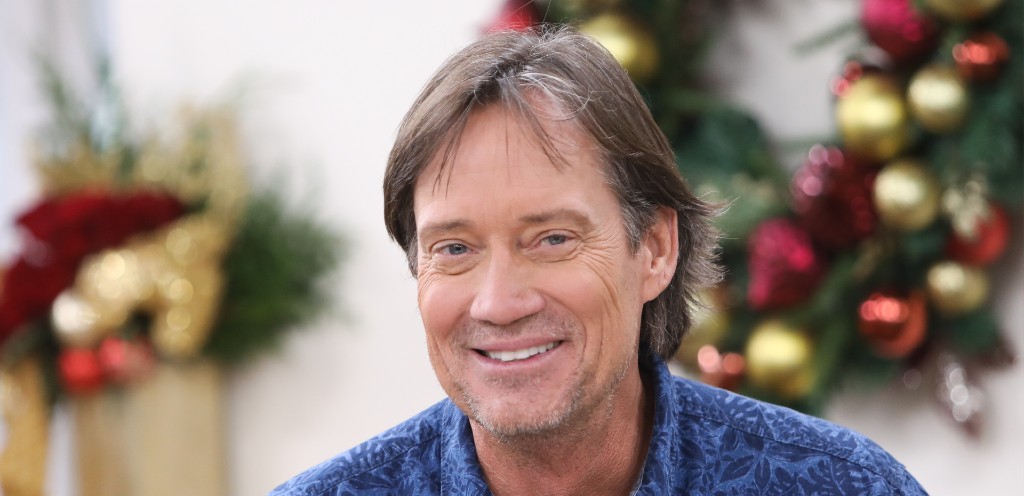
Kevin Sorbo Is Being Dragged For Making Fun Of Hunter Biden’s Struggles With Drug Addiction

To most people, Kevin Sorbo is that guy who played Hercules on a TV show over 20 years ago. What some might not know is he’s a big outspoken conservative — almost as huge as Scott Baio, who was on a TV show over 30 years ago. If he makes news at all these days, it’s for getting owned by Lucy Lawless, star of the Hercules spin-off Xena: Warrior Princess, after he tweeted baseless lies about the failed MAGA coup. Cut to a few weeks later and he’s getting dragged online again, this time for making fun of Hunter Biden’s drug addiction.

“Tell Hunter Biden he forgot to pick up his lap pipe,” wrote the onetime Kull the Conqueror. “I mean crack top. I mean, I… you know the thing.”

The president’s son has long been a fixation of the far right, who’ve singled him out for alleged corruption, even by the former president’s corrupt sons. They also like to focus on Hunter’s struggles with drug and alcohol addiction, sometimes even mocking his father for caring about his son’s personal issues. So when someone who has been outspoken about his deep Christian beliefs thought it was a good idea to make fun of someone’s addiction issues, people remembered that he existed.

To his credit, Sorbo has eked out a career, albeit by pandering to the far right. He played a mean atheist professor in the first in the God’s Not Dead series, and he also wrote, directed, and starred in Let There Be Light, in which he played a mean atheist who comes to believe in the Christian god. What other actors can say they can only play two roles: Hercules or jerky non-believers? That’s range!