Last week, I laid out the case that Kaley Cuoco, who stood at a crossroads at the 2019 end of The Big Bang Theory‘s twelve season run, is swiftly proving that many of us underestimated her talents. She’s already distancing herself from her stereotypical “dumb blonde” neighbor act with two roles in projects that she’s also executive produced (and therefore has a say in what goes down and how). The first role would be the deliciously profane voice of animated Harley Quinn (recently renewed for a third season on HBO Max), and the second project’s one of the first original series (albeit a limited one) on the same streaming service. Both series are savvy choices that go a long way to convince me that Kaley’s well-aware of her strengths, and she’s not afraid to use them to her greatest advantage.
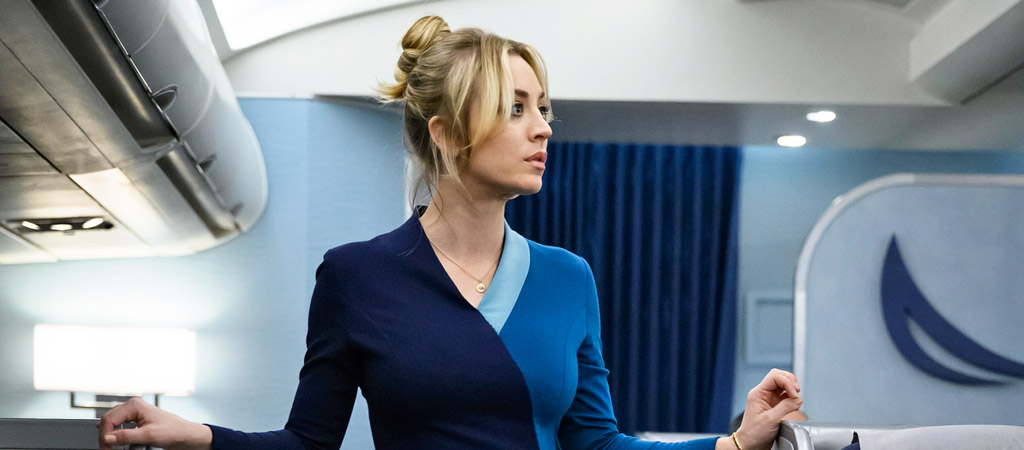
HBO Max’s The Flight Attendant does play up those assets, namely Kaley’s comedic timing and flair for communicating “frazzled” but not “flustered.” It’s an important distinction to enjoying her character here, in what’s a pretty simple setup. Kaley portrays (you guessed it) an airline stewardess (Cassie) with an international jet-setting lifestyle. She’s a boozy mess, probably even a functional alcoholic (so many tiny vodka bottles), never growing too close to (almost) anyone. She falls into bed in various countries with various handsome men. During the course of one particularly fateful and ill-advised encounter, Cassie’s life (along with chunks of her sanity) careens right off a cliff.
HBO Max
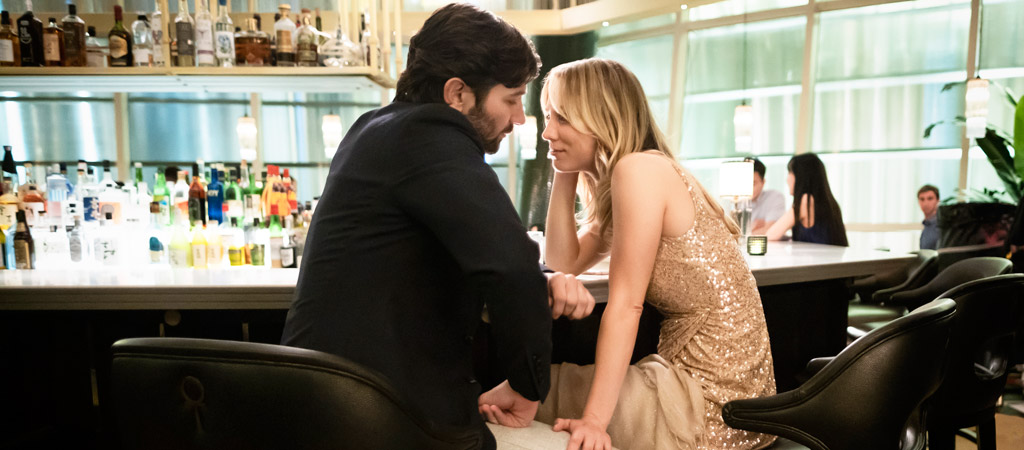
In short, she blacks out and wakes up next to the bloody corpse of a one-night stand. Does she call the cops? Nope. Cassie does a terrible job cleaning up after herself, which means that she spends the next several episodes attempting to convince U.S. federal agents that she did not kill this fine American man. There are other things going on, of course, but there’s also a simplicity to this madcap quandary that I can appreciate.
That’s one level of how one can enjoy this show. It’s dark stuff, yes, and traumatic as well. Somehow, it’s also very funny, which is down to the absurdity of the situation, along with Kaley’s reactions to each piece of fresh hell that Cassie’s enduring. This isn’t a particularly smart series (nor does it take itself too seriously), but it is a clever one and a free-falling flight that careens through obstacles with such momentum that it’s easy to look past any plot holes. Instead, one can simply relax and witness Cassie’s not-so-slow descent into losing-her-sh*t-land while piecing together the details of her night.
It’s also possible to opt into a deeper level of watching this show, though that isn’t necessary. As in, there are multiple ways to weigh Cassie’s dilemma, which allows the audience to dive into the relevance of flashbacks that she experiences, sometimes years or decades into the past. One can mull over why this character set up a lifestyle for herself that allows her to rarely form a meaningful connection. Or one can consider how unavoidably messy Cassie’s inner state is compared to her glossy outward appearance. Then there’s the blackout factor, which presents questions about whether someone who’s accustomed to doing “silly” drunk things can possibly make the leap to murderer.
No obvious answers materialize for those considerations, at least, not in the first half of the season that’s been screened for critics. Instead, clues appear, and many of them arrive in surreal circumstances, so the show really does a fine job of veering away from predictability traps. It’s a whirlwind ride, too, with polished production values gliding through exotic locales with the well-timed click of high-heels through an airport. All of the action appears to flow so effortlessly that it’s easy to surrender to the flow, and although this show revolves around a present trauma, it’s almost relaxing to see Cassie frenetically attempt to clean up a compounding disaster. Maybe that’s partially because our own world has grown so absurd and out-of-our-control. It’s rather nice to watch a stressful situation play out in a surprisingly funny way and with the confidence that, somehow, a pilot shall guide this mess to a landing.
This is, through and through, Kaley Cuoco’s show, and she is very clearly having a ball with her character. Yet she is aided by some steely supporting players, mostly the ladies. Zosia Mamet gets to step outside the best friend box and play an attorney who isn’t afraid to slide all sorts of game pieces around. Rosie Perez plays a sketchy flight attendant colleague, who’s really more of a frenemy. And Michelle Gomez slides in and out of the picture as a possibly evil influence (after most recently playing Madam Satan in Chilling Adventures Of Sabrina). All three women spark different reactions and emotions within Cassie, while she tries to pick up the pieces and figure out exactly how her life has spiraled so far out of control that she’s ended up in this horrific position.
The Flight Attendant is a bloody affair that’s spiked with pitch-black humor. You’ll laugh at the scene where Cassie wakes up next to a virtual stranger’s body, and you won’t feel bad about doing so. Yes, that’s a weird statement to make in a show that frames itself around a brutal killing, but mostly, this adventure is about watching Kaley Cuoco stretch her legs down the aisles of leading-lady land. It’s also, at times, a chillingly captivating tale that charms without a heavy-handed touch. And it’s a fine choice to binge some hours away with multiple episodes dropping weekly. Take the trip, and place your trays in an upright position while you prepare for takeoff.
HBO Max’s ‘The Flight Attendant’ will run three debut episodes on November 26.
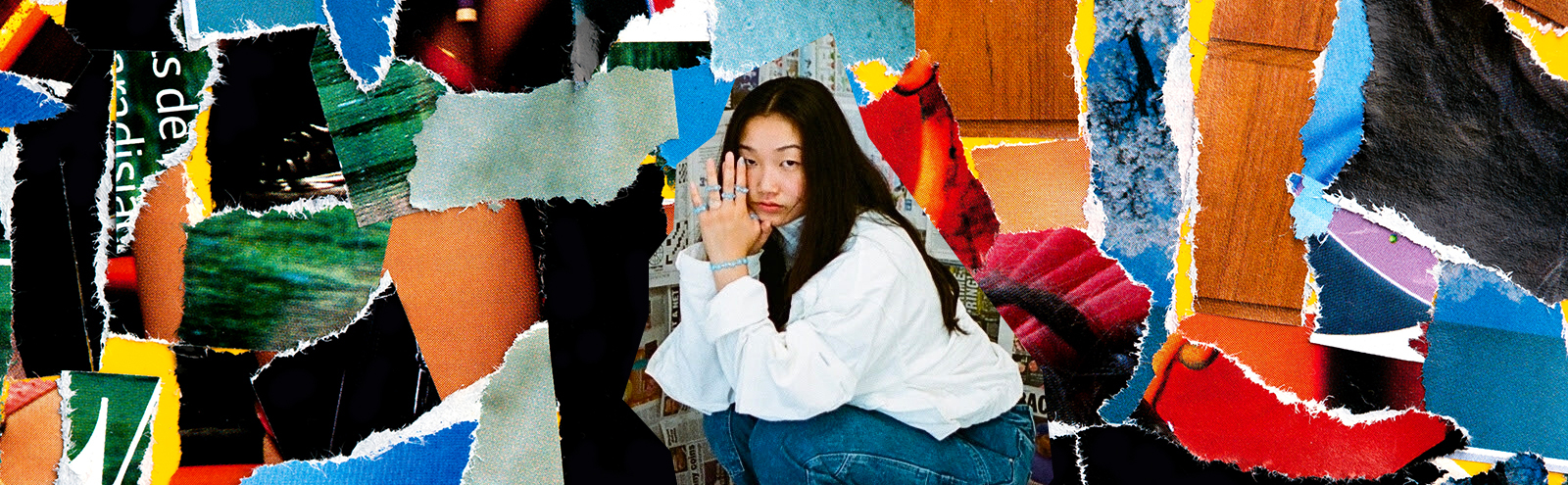
Over the last two years, hip-hop and R&B artist Audrey Nuna has been making quite the name for herself. Born and raised in New Jersey, the Korean-American musician has developed an avid following for her amalgamation of haunting R&B melodies, catchy techno, and smooth rap. But for Nuna, her style has become every bit as much of her brand as her music: Her effortless mix of formal and street styles echoes the collision of culture in her upbringing (Sade, Thundercat, and Korean media are all influences in her work). And modern accessories pay homage to the glitchy, experimental sound in every track she releases.
Lately, Nuna has been gravitating towards pre-professional wear — “Button-ups, collared shirts, stuff I would never actually have to wear because my job is not very corporate” — and drawing heavy influence from her Korean heritage. But Nuna’s attention to fashion has long played a big role in her music videos. A transparent vinyl jacket with embedded paper money bills stole the show in “Paper,” for example, while flannels and loud acrylic chains were the focal point of “Comic Sans (feat. Jack Harlow).” Her most recent release, “Damn Right,” put Nuna’s unique, futuristic aesthetic front and center with eclectic looks reminiscent of characters in a video game.
To dive into that further, we asked Nuna to discuss three of her favorite looks. Read on to learn more about her favorite brands, how grandpas are one of her biggest inspirations, and who her fighters would be.
How would you describe your style?
I’ve been going with futuristic dad-slash-grandpa. I’m very into minimalism and neutrals with pops of color. I love when there’s a middle ground between high and low fashion, like futuristic stuff but also nostalgic shit. Also been into skatewear, as well as pre-professional wear lately. That’s the whole she-bang-bang.
How do you bring all these different styles together?
I just try different shit, and if it feels good, then I’m like, cool. It’s kind of like making music, you don’t really know what you’re doing but you just try shit. And then if it feels good, you kind of know. And if it doesn’t, then you should just change. [Laughs]
What brands have you been into lately?
I love a lot of South Korean designers. Hyein Seo. She’s based in South Korea and she does a lot of futuristic, really interesting silhouettes. Really interesting, strappy, almost anime-style clothing which is really fire. I also love IISE, which is another brand based in Korea. They do a lot of modern clothing that ties back to ancient Korean times.
I love how you’re tapping into your roots for fashion inspiration.
I never really thought about it when I was a kid, but as I’m growing up, I’m like, oh…there is actually a whole country of people who look like me. That blew my mind. When I went to Korea for the first time as a young adult, I was like oh shit, the entire country — everyone’s faces are similar to mine. That’s wild.
I really gravitate towards what they’re doing over there. Someone told me South Korea is, like, 7 years ahead [in terms of fashion trends]. Then Europe is like 3 years behind them. And we get all the trends last. [Laughs] But I believe it, they’re just on some other shit.
Outside of fashion, where do you draw inspiration?
I actually take a lot of pictures of strangers. I know that’s really weird. I’ll be walking on the street, and I’ll see a construction worker, or a grandpa. A lot of grandpas on my photo roll, just random grandpas I’ve never talked to because they go so hard! And they’re so underappreciated. Definitely a lot of industrial — I have photos of certain hard hats that are really cool. And it’s so funny because I literally just sneak photos all the time. People think I’m taking selfies, but I’m never talking selfies, guys — I’m taking photos of you.
I think Asian grandmas honestly go the hardest.
Yo, my grandma, she sent me this photo the other day and I was just like, “What the… you’re so hard.” She’s flashing a ring that she made me — it’s all gemmed out — and she didn’t want to show her face, so she’s just [covering it] like this. That should be a single cover. I think it will be actually.
What’s the relationship between style and music for you?
I definitely think they come from the same part of my brain. I know that I have a song that I love if I start to see a visual in my head because they’re so linked to me. I’ve also thought about maybe doing something where I pair up with an illustrator or visual artist. They’ll make the visual art first and that will be my north star in terms of the sonics. I’m curious to see how the music would be affected if I were to do visuals first.
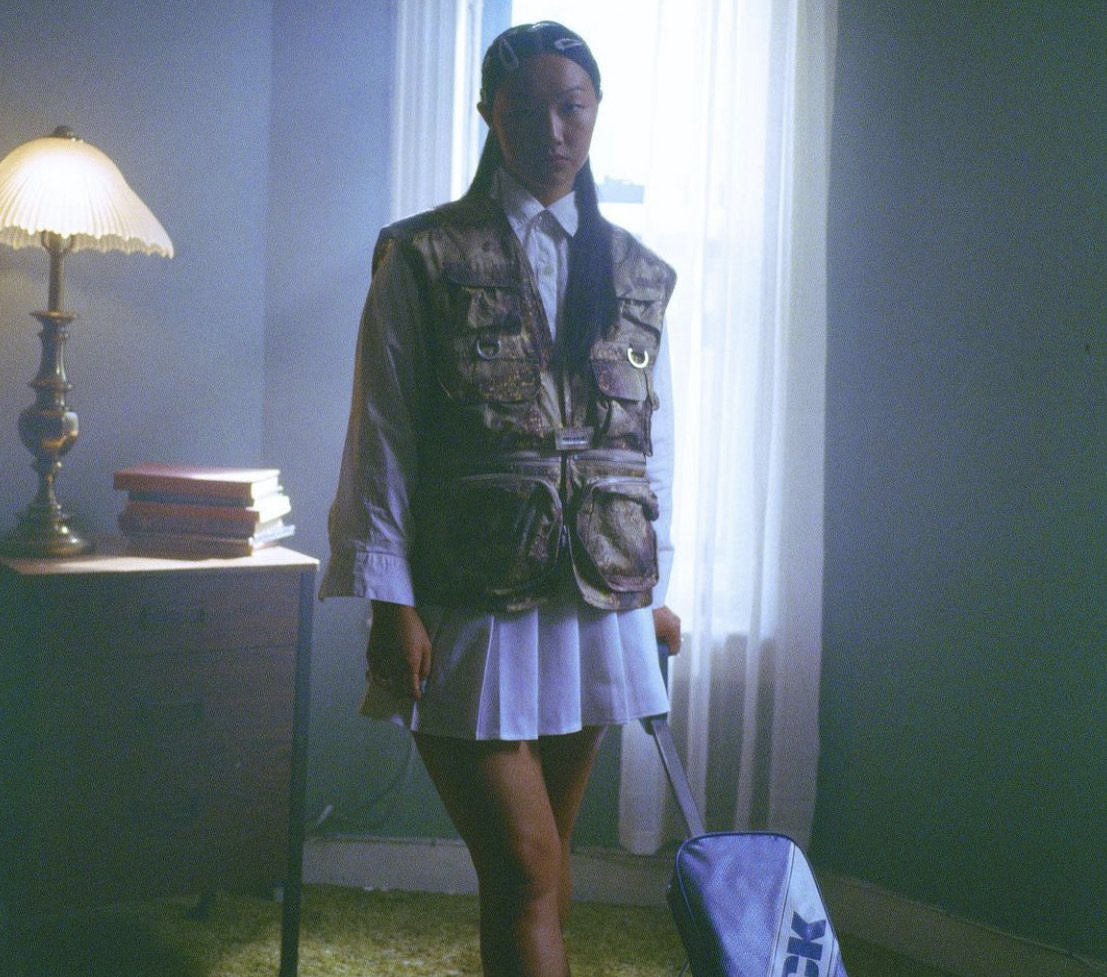
Look #1: “Housewife Who Makes More Money Than You”
Khufu Najee
This look is from the “Damn Right” video. What were you thinking when you put this together?
First of all, I was trying to get a stylist for the video but no one responded in time, so I ended up just being like fuck it, I’m gonna do it myself. The fit is kind of what we’re talking about actually. The collared shirt paired with the streetwear, paired with the tennis skirt. The tennis skirt is definitely a new thing for me, but I wanted to do something that felt a bit domestic ‘cause I was gonna be vacuuming.
And the cliiiiips, the hair clips! I saw a meme on Instagram where this girl had all these straight bobby pins in her hair, being like “2020 so far” and just making fun of her hair. So I thought, what if it was even more disorganized and used bejeweled clips from eBay?
I noticed the skirt because I feel like you don’t really wear skirts. There’s such contrast to me between the masculine energy of the vest vs. the super girly skirt.
Actually, that’s so funny because it definitely did feel like a pivot moment for me. I was like, wait, I really want to wear a skirt for some reason. I get really bored of myself easily, so I always want to switch shit up. That was kind of the impulse behind the skirt, but also that weird middle ground between masculinity, femininity — I love exploring that. Genderless clothing is fire to me.
If I were to start a brand, I would want anyone to wear it; it’s not a women’s or menswear brand. I think there are so many societal norms about how a girl should dress. I’m just bored by it.
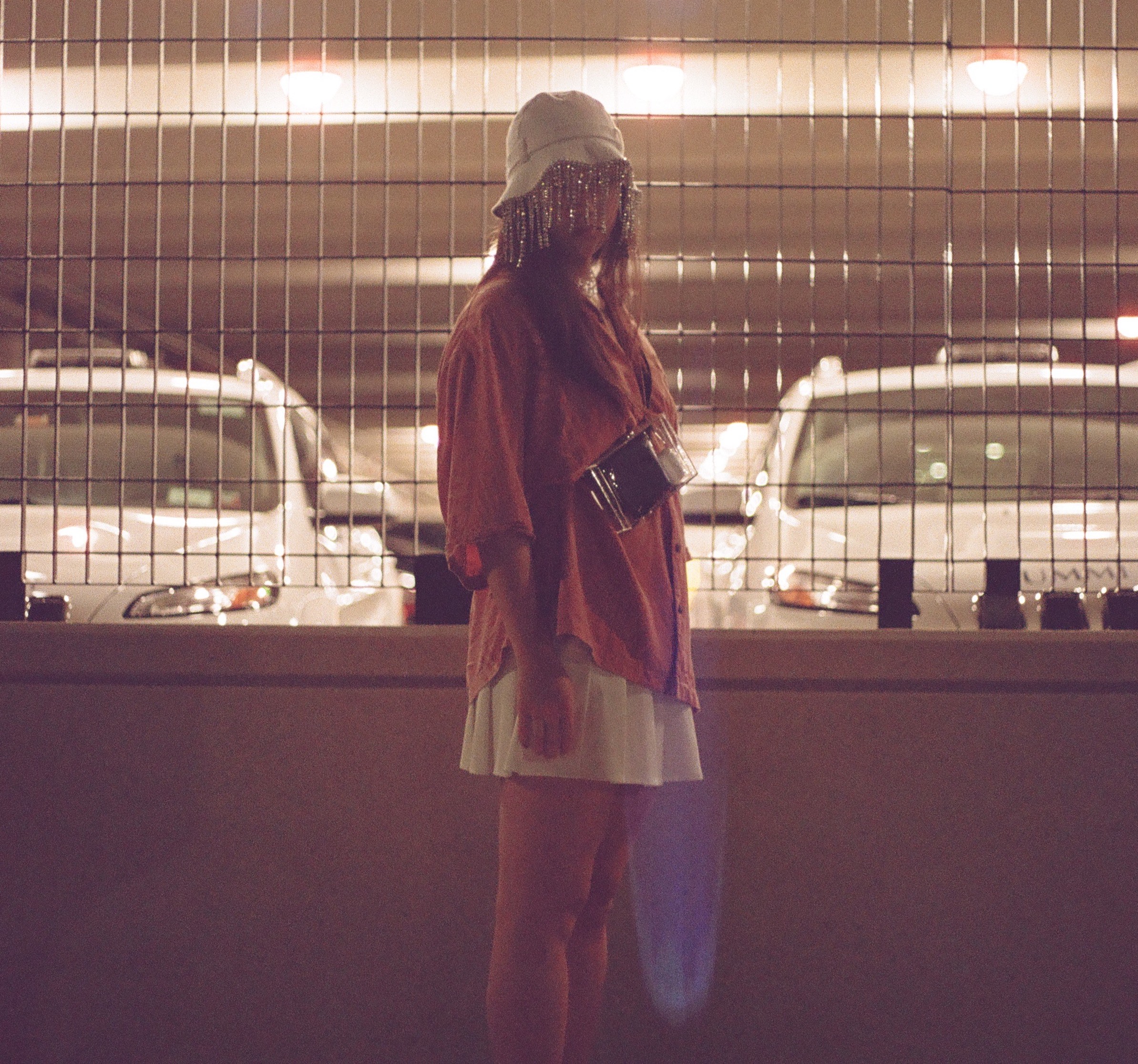
Look #2: Modern Chosun Era Bodyguard
Ashtro
What’s your favorite part of this outfit?
I love the bucket hat. My grandma actually made that for me. My grandparents came to the states to do clothing manufacturing. That’s also what my dad did instead of — he wanted to be an architect, but he was kind of forced into what his parents were doing. So I grew up in that space a lot. Every “take your kid to work” day, I would go with him; I loved doing that stuff.
My grandma makes a lot of my — we collaborate a lot, actually. I also love the [Asos] bag. The plastic messenger bag goes hard.
What was the inspiration for the hat?
I used to watch these Korean Chosun-era ancient dramas. In them, there were these female ninjas who wear hats with veils that cover them, and their job was to protect the queen and murder people who tried to murder her. So the hat was inspired by that…I would call it like a “modern Chosun era bodyguard.”
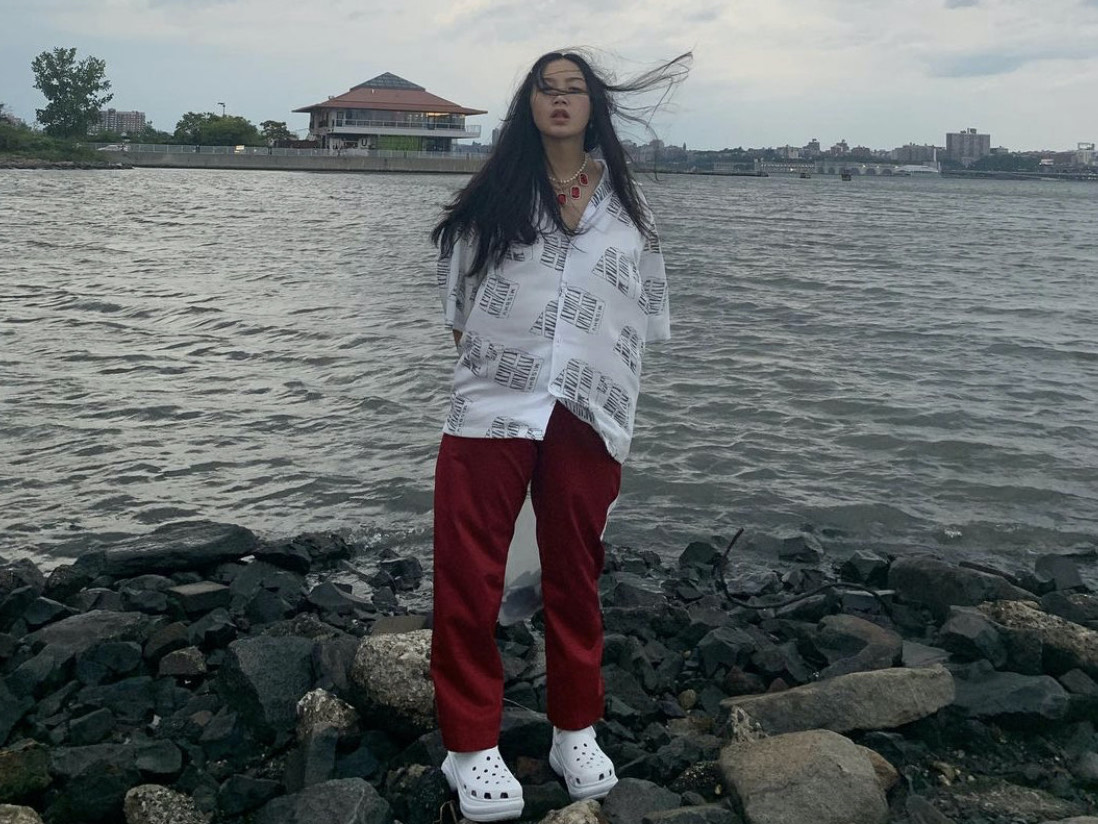
Look #3: Korean Gangster Grocery Shopper
Ashtro
This look feels the most different to me from the others.
Yeah, this is just a random day in my life. Casual wear.
But even then I see elements of subtle coordination. Like your necklace colors kind of mimic the stacking that’s happening in your outfit.
I love those pearls. They’re fake. Everything is fake; I’m very shameless with that. I’m just honestly not that bougie. There are a lot of clothes that I like that just happen to be expensive, but I will rock anything. Even the Crocs. Everyone was begging me not to get crocs, but I was like fuck y’all — I’m getting crocs. And those shits are so comfortable too! The pants are from IISE. The shirt is from MISBHV. They’re one of my favorite streetwear brands. This is just kind of simple — I would call this one my grocery store outfit.
I think this is a pretty swaggy grocery store outfit.
It’s crazy because I never realized until speaking with you, but I really do draw a lot of influence from Korean culture. Because I was gonna say there’s a lot of Korean gangster movies I’ve seen as a kid. And this is how they dress. They got the Cuban shirt, with some corny colors that somehow go hard. This is like the “Korean gangster grocery look.”
Ever since The Good Place ended earlier this year (which seems impossible; I could have sworn the finale aired three years ago), the number of live-action network sitcoms I watch is now… when does Brooklyn Nine-Nine come back? But I am genuinely excited about Mr. Mayor, a new NBC comedy from 30 Rock and Unbreakable Kimmy Schmidt‘s Tina Fey and Robert Carlock and starring Ted Danson. It’ll be nice to evil laugh again.
Mr. Mayor “follows a retired businessman (Ted Danson) who runs for mayor of Los Angeles to prove ‘he’s still got it.’ Once he wins, he has to figure out what he stands for, gain the respect of his biggest critic and connect with his teenage daughter, all while trying to get anything right for America’s second weirdest city,” according to NBC. The show has a stacked cast — outside of 18-time Emmy nominee Danson, there’s also Holly Hunter, Crazy Ex-Girlfriend‘s Vella Lovell, and Ass Dan himself, Bobby Moynihan.
The last thing the world needs is a show about politics, let alone a comedy. And yet! Maybe this will be a Succession situation where the quality of the acting and writing trumps (poor word choice) the nightmare-sounding premise. Mr. Mayor looks light and goofy and fun, and anything with Danson, Fey, Carlock, and Moynihan deserves a shot.
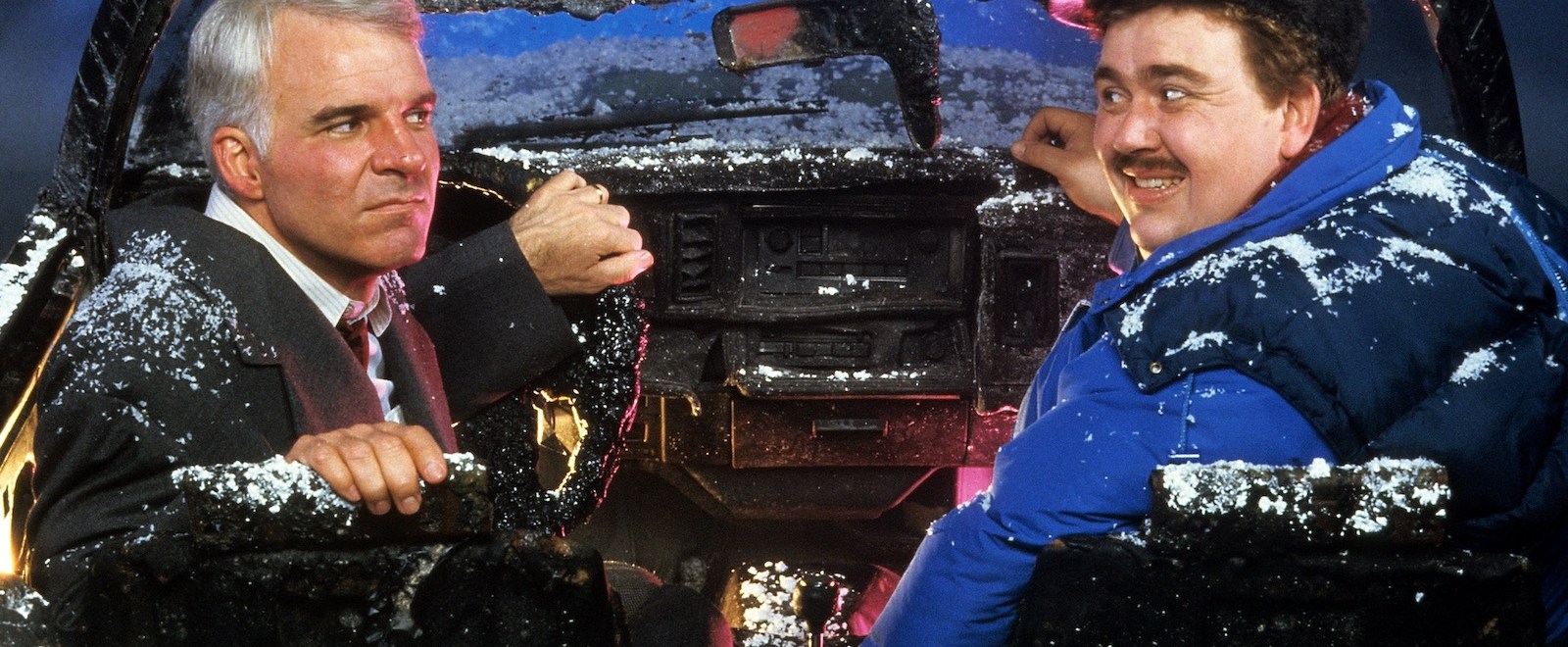
Every year, I’m dismayed by the shelf life of John Hughes’s Planes, Trains and Automobiles. It’s a movie I love and would watch numerous times over a holiday season, if the particular holiday it represents didn’t come and go so quickly. For example, any given December I can watch Scrooged three or four times. But Thanksgiving comes and goes so quickly, in that there’s no real “season,” we get, maybe, a one-week window to watch Planes, Trains and Automobiles. Compare this even to Halloween, when the whole month of October is “scary movie month.” Planes, Trains and Automobiles just kind of feels like a movie that should be on television as much as Home Alone or National Lampoon’s Christmas Vacation, but, instead, will disappear into the ether in the next four or five days.
Anyway, yes, I did re-watch Planes, Trains and Automobiles recently and, for reasons that should seem self-evident, it was a tough watch, more than it even usually is. And it usually is anyway because, despite how funny it is, John Candy’s Del Griffith is such a tragic figure. His arc makes me very sad. And that’s not even getting into Candy’s untimely death just a few years later, which compounds the whole thing. This movie has always made me sad, but yet I still watch it. And this year it’s made me even sadder.
I didn’t like Thanksgiving until I moved to New York City. In fact, for many years watching Planes, Trains and Automobiles was the most Thanksgiving-themed thing I participated in. I grew up an only child and, on my mom’s side of the family, I am somehow an only grandchild. I don’t even know any other only grandchildren. I think that’s a hard thing to pull off, even though I personally had nothing to do with it. But this made for pretty small Thanksgivings – to the point that I don’t really have many memories of them. And whatever we did do, I was always the youngest by about 30 years. You know that scene we always see in movies, of a large family around a big table with a big turkey in the middle? I never experienced that. But then I moved to New York and, for a good stretch, I’d go over to a friend’s house for Thanksgiving where a bunch of other people who didn’t travel back home for the holiday would also congregate – people around my own age even! I really enjoyed this. It felt like an episode of Friends. (There were a couple of bad Thanksgivings thrown in during this time period where I’d be invited to someone’s house to spend the holiday with their family – and I legitimately did not know how to act or what to do with myself because I had no prior Thanksgiving training. These were unnecessarily stressful events for me.)
So, for the most part, my appreciation for Thanksgiving has grown over the last few years. Then in 2017 my dad unexpectedly died five days before Thanksgiving. Though, it was weird: instead of disliking the holiday even more, I kind of found myself throwing myself into it. To the point, in the years that followed, I actually started going back home to Missouri again to be with my family, something I hadn’t done since I moved.
Look, the pandemic has sucked. But I will say that I am a little less forlorn about my lack of travel and “attending events” than I thought I’d be. It’s probably due to how bad New York City was back in April, but my mindset has landed on “being safe” and, at least, doing my part to not personally take up space in a hospital, or possibly infect others and send them to the hospital, outweighs any personal need I have for “fun.” (And this is the part I just can’t get over about the Ted Cruzs of the world making Thanksgiving some sort of culture war and that real tough guys go ahead and have Thanksgiving. In the end, it makes hospital workers’ lives harder and why any sort of rational human would do this to them is beyond me.)
Anyway, this time watching Planes, Trains and Automobiles, I didn’t feel as sad for Del. At the end, he got to be around people who wanted him to be there. (I always do wonder what Neal and Del’s future relationship would be like. It’s nice to think it became a tradition that good ol’ Del would come over every Thanksgiving.) I just felt sad that, this year, I couldn’t go home: something I only recently discovered was important to me. And I’m sad for all the people who are in similar situations. And, I suppose, even the people who are going ahead with it anyway, and all the tragic stories we will for sure read in the future about how that all turned out. In comparison, Neal and Del’s story feels a lot simpler. Instead of the story being tragic, I found it, instead, hopeful.
Also, when was the last time you watched the “unedited for television” version of Planes, Trains and Automobiles? It hit me that I guess I hadn’t in quite a while and didn’t realize I was watching the real version, because when Steve Martin goes into his tirade on poor Edie McClurg at the airport rental car counter, I found myself legitimately shocked. Which tells me it had been a long time since I had seen the unedited version of that scene. The movie does such a great job of keeping everything pretty subtle to that point, that by the time Steve Martin goes into his eff-bomb tirade, it really feels like it comes out of nowhere. It’s like we are expecting some sort of intellectual faux snooty takedown – don’t forget, Neal thought a busload of travelers would be familiar enough with “Three Coins in a Fountain” for a singalong – but, instead, Neal just hits us over the head with the most vulgar thing he can say. It’s brilliant. (It should be noted that scene was filmed in St. Louis and as someone who has been to that airport many, many times, there is a something quite cathartic about the whole endeavor.)
I think, this year, I’ll watch Planes, Trains and Automobiles a few more times. Even beyond its yearly expiration date. Even into …. December. It captures something about missing home better than most of the other, even more Christmas themed movies do. For me this movie is Thanksgiving. And, this year, it feels like it’s all we’ve got – and it’s going to have to last a bit longer than usual.
You can rent ‘Planes, Trains, and Automobiles’ via Amazon Prime, Google Play, YouTube, and Vudu. You can contact Mike Ryan directly on Twitter.
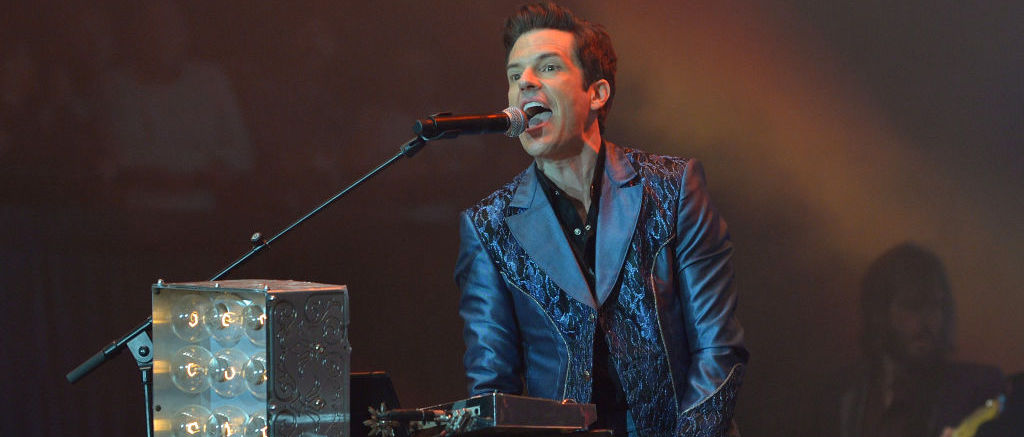
Yesterday saw the Recording Academy’s announcement of the nominees for the 2021 Grammys. The news brought about much controversy, mostly related to artists like The Weeknd who virtually everybody felt didn’t get the recognition they deserved. Now The Killers, whose new album Imploding The Mirage was released just before the end of the 2021 Grammy eligibility window, have jumped on the “we got snubbed” train with a hilarious tweet.
The band didn’t receive any Grammy nominations this time around, so their lifetime nomination count remains at five. They decided to respond to that news with a tweet poking fun at Donald Trump’s reluctance to accept the results of this year’s presidential election, which went in Joe Biden’s favor. Hitting caps lock and writing about Grammy conspiracies, the band tweeted, “OBSERVERS WERE NOT ALLOWED INTO THE COUNTING ROOMS. WE WON THE GRAMMYS, GOT LOADS OF LEGAL VOTES. BAD THINGS HAPPENED WHICH OUR OBSERVERS WERE NOT ALLOWED TO SEE. NEVER HAPPENED BEFORE. DOZENS OF BALLOTS WERE SENT TO PEOPLE WHO NEVER ASKED FOR THEM! #RIGGEDGRAMMYS #WEWON.”
OBSERVERS WERE NOT ALLOWED INTO THE COUNTING ROOMS. WE WON THE GRAMMYS, GOT LOADS OF LEGAL VOTES. BAD THINGS HAPPENED WHICH OUR OBSERVERS WERE NOT ALLOWED TO SEE. NEVER HAPPENED BEFORE. DOZENS OF BALLOTS WERE SENT TO PEOPLE WHO NEVER ASKED FOR THEM! #RIGGEDGRAMMYS#WEWON
Had The Killers been nominated this year, they would have been looking for their first win, as they came up empty with their five previous nominations. It’s been a while since the band’s last nomination: “When You Were Young” was nominated for Best Short Form Music Video in 2006.
Find the (mostly) complete list of 2021 Grammy nominees here.
(Editor’s note: This piece was originally published in 2016. We republishing it today to commemorate Thanksgiving.)
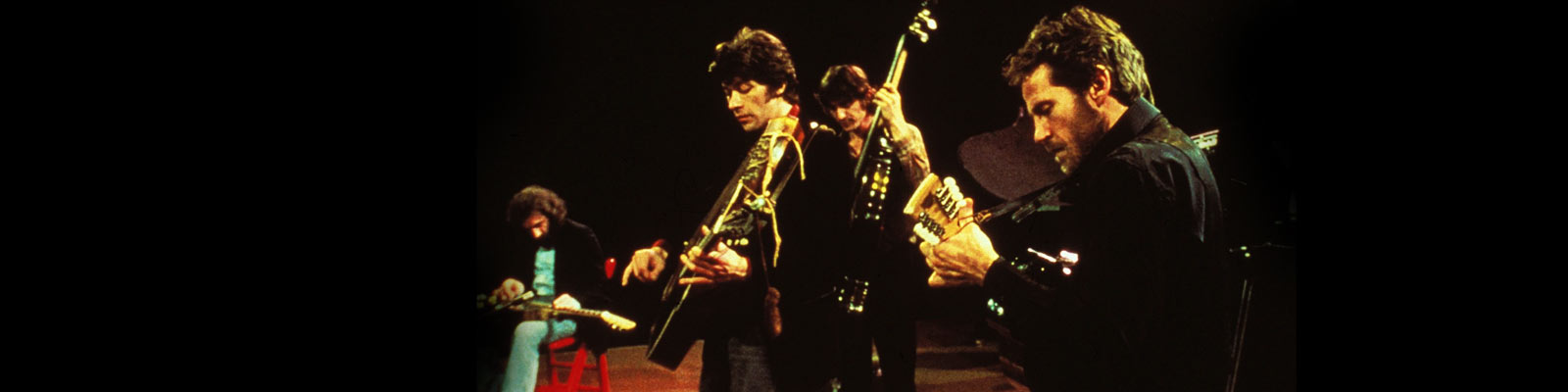
The Last Waltz is a concert film directed by Martin Scorsese about a star-studded “retirement” show by The Band that occurred 40 years ago on Thanksgiving day in San Francisco. The co-stars are Bob Dylan, Van Morrison, Neil Young, Joni Mitchell, Muddy Waters, Dr. John, Neil Diamond, and about another half-dozen rock stars from the ’60s and ’70s. Every year around this time, I try to watch The Last Waltz at least once, in the way that people watch A Christmas Story or It’s a Wonderful Life whenever mid-December rolls around. I’ve come to regard The Last Waltz — and I preface this by offering sincere apologies to Planes, Trains, and Automobiles — as the greatest Thanksgiving movie ever. That’s not simply because The Last Waltz takes place on the holiday, but also because this film embodies what’s wonderful, horrible, hilarious, and moving about one of this country’s most sacred annual traditions, and how many of us manage to survive it. Other films have used Thanksgiving as a backdrop. But to me, The Last Waltz is Thanksgiving.
Allow me to recount the plot of The Last Waltz: A dysfunctional family of five brothers has decided to stop living together. Before they split up, they invite a coterie of friends dressed in colorful suits and floppy hats over for a holiday celebration. Despite years of pent-up resentment — the brother with the amazing voice loathes the brother with the amazing haircut, whom he views as disloyal and undermining — all parties agree to put these tensions aside and put on a good face in front of the guests.
The guest list at this party is truly a mixed bag. There is a wise old man from Mississippi. There is a beautiful blonde poet from the Hollywood hills. There is a jive-talking hipster from New Orleans. There is a coked-up Canadian hippie. There is a portly, purple-suited Irishman who mistakenly believes that he knows karate. And then there’s the Jewish rock star for Minnesota who can’t decide if he really wants to be there.
Thus far, it sounds like I’m describing a Wes Anderson film. And, in some ways, I am — beneath the formalism of the filmmaking is a whole lot of messiness.
On the surface, the party is lavish — there are chandeliers on loan from Gone with the Wind (really!) and the lighting is bold and theatrical and there are famous writers reciting indecipherable passages from Chaucer. Beyond the pomp and circumstance, however, it’s like the bowery. Nearly everyone is sneaking away to get smashed on booze and smuggled chemicals — this is out of habit, but also because family reunions tend to be fraught with tension. It is the most certain of all inalienable truths. The trio of sweet, soft-spoken brothers know that the brother with the amazing haircut will be overbearing and arrogant, and that the brother with the amazing voice will make his stirring but problematic case sympathizing with Southerners who lost the Civil War. And the sweet, soft-spoken ones will once again be caught hopelessly in the middle. You feel for them. Weird politics and flawed family dynamics – who can’t relate to dreading these things at this time of the year?
And yet — in spite of the resentments, and the betrayals, and the intensifying intoxication — everyone is able to come together and conjure a feeling of community. When they gather around to tell old family stories that have been told and re-told umpteen times — like the one about Jack Ruby, or the one about shoplifting bologna and cigarettes — the brothers pretend to laugh whenever the overbearing brother takes over the conversation. (The upside of being on stage is that you can turn off his microphone.) After a while, the laughs seem less forced. They’re faking it so well that they start to feel actual community and love and understanding. This is what The Last Waltz, and Thanksgiving, is all about.
Earlier this month, Robbie Robertson put out a memoir, Testimony, that concludes not long after The Last Waltz. (Condolences to anyone hoping for an in-depth, behind-the-scenes look at the making of 2011’s How To Become Clairvoyant.) My feelings about Testimony are as conflicted as they are about Robertson — he’s a great artist and an insufferable person, and Testimony similarly is artfully rendered and often hard to stomach.
As is my custom with rock memoirs, I’ve been reading Testimony out of order, in order to get to the parts that most interest me. The Last Waltz is near the top of that list. Robertson was the chief engineer of The Last Waltz — he conceived the concert, brought on Scorsese, and acted as the film’s producer. Unsurprisingly, his view of the concert is sanitized and romanticized — he goes into deep (perhaps unnecessary) detail about the conception and planning of the concert, recounting every personnel hire and rehearsal. Of course, every move is confirmation of Robertson’s genius.
For people that have seen The Last Waltz as many times as I have, Testimony will be interesting be default. Because I am one of those nerds who is curious about any and all minutia related to this concert, including what Van Morrison was wearing before the show. (“A beige trench coat,” Robertson writes, clearly less exciting than the extravagant purple jumpsuit he wore on stage.) For anyone else, however, Robertson might seem ponderous. He heaps praise upon the performers, particularly Neil Diamond, who in Robertson’s estimation performed “Dry Your Eyes” (which Robertson co-wrote) “like a sermon out of Elmer Gentry.” Robertson even spends a paragraph describing the Japanese bath in his San Francisco hotel room.
As for the other guys in The Band… well, Robertson admits that they weren’t as into the film as he was, but “they didn’t have the cinematic passion that I did.” Hm … sounds a little fishy, Robbie.
At that point, I decided it was best to chase what I was reading in Testimony with some passages from Levon Helm’s scathing 1993 book This Wheel’s On Fire, a dishier and more overtly nasty book than Testimony.
(Notice that I said “overtly” — Robertson isn’t above score settling, he just does it in a more magnanimous tone. For instance, when describing a disastrous 1970 gig at the Hollywood Bowl, Robertson hints that Helm’s heroin addiction adversely affected The Band’s performance, though he later diffuses the accusation by adding that Helm himself admitted as much after the show. Why Robertson chose to write about a forgotten concert — and throw Helm under the bus 46 years later — is a mystery. Though, perhaps, it does explain why he waited until after Helm died to write a book.)
In Testimony, Robertson claims that when he brought up the idea of a retirement concert to the guys in The Band, “no one was opposed to the idea.” Even Helm “knew we couldn’t continue with out live shows.” If Robertson really believes that, then I suggest that he read This Wheel’s On Fire. Helm’s take on The Last Waltz is unequivocal: “I didn’t want any part of it,” he writes. “I didn’t want to break up the band.”
In Helm’s version of events, Robertson pressed Helm about the dangers of the road, and how it took the lives of everyone from Hank Williams Sr. to Jimi Hendrix. “Every time I get on the plane I’m thinking about this stuff,” Helm recalls Robertson saying. “The whole thing just isn’t healthy anymore.”
“I’m not in it for my health,” Helm replies. “I’m a musician, and I wanna live the way I do.” (This quote later inspired the title of the heart-rending 2013 documentary, Ain’t in It for My Health: A Film about Levon Helm.)
Helm claims he only went along with The Last Waltz because management made it seem that he had no choice — whether that’s really true or if it speaks to the same self-defeating fatalism that caused Helm and the rest of the Band to slowly cede control to Robertson, it’s hard to say. Like so many families, the Band was undone by money problems. Robertson was credited as the Band’s primary songwriter, a distinction that Helm felt put too fine a point on the group’s collaborative process. At one time, these men freely pooled their talents and personal experiences for the common good. While Robertson technically wrote “The Night They Drove Old Dixie Down,” the song’s authenticity and soul came from Helm. But that partnership was over by the time of The Last Waltz.
In The Last Waltz, Robertson’s dark proclamations about “the road” form the narrative, while Helm’s contrasting view goes unacknowledged. This inevitably influenced Helm’s view of the film. When Helm finally saw The Last Waltz, he “was in shock over how bad the movie was,” he writes in This Wheel’s On Fire. Helm hated how many overdubs there were. (In Helm’s book, the Band’s producer John Simon claims that the only tracks that weren’t re-recorded were Helm’s vocals and drums.) Helm hated that Scorsese (whom he refers to, hilariously, as “the dummy”) didn’t shoot the dress rehearsal or any of the pre-show festivities orchestrated by concert promoter Bill Graham, which he felt were some of the best parts of the event.
Most of all, Helm despised Robertson’s “world-weary angst” about the life of touring musicians. In Helm’s view, this was like a gangster trying to leave the mafia. Ultimately, Helm felt that Robertson sold out his former comrades. “To me,” Helm concludes, “it was unforgivable.”
All of this stuff composes the poisonous subtext of The Last Waltz. Perhaps it’s easier to enjoy the movie if you aren’t aware of it. Or if you stick with Testimony and ignore This Wheel’s On Fire. But for me, the subtext actually deepens the experience of watching The Last Waltz.
I don’t think the movie would be as rich if it was simply about an old ’60s rock group that decided to hang it up. The tension between the joyous performances and the embittered back-stage reality is what gives The Last Waltz its emotional and spiritual power. If Helm really hated being there, then his ecstatic yodeling at the end of “Up On Cripple Creek” is all the more remarkable. If Rick Danko was already focused on his solo career — when Scorsese tries to interview him in The Last Waltz, Danko instead plays the luminous “Sip The Wine” from 1977’s Rick Danko — then his definitive performance of “It Makes No Difference” is that much more awe-inspiring. If Richard Manuel already seemed to be on his last legs, as both Robertson and Helm suggest in their books, the courageous grit he lends to “The Shape I’m In” is flat-out heroic.
(Garth Hudson is the only member of The Band I have not yet directly referenced. I am the one billionth person to make this mistake when talking about The Band, but only because he was seemingly unbothered by the humanoid craziness surrounding him in The Last Waltz. To quote Ronnie Hawkins, Hudson was werrrd, a musical genius living in his own solar system.)
Perhaps Helm’s point of view made it into The Last Waltz after all. No matter what Robertson says about the impossibility of road life, the rest of the guys refute by showing. These musicians are so devoted to their craft that they can perform masterfully, no matter the circumstances. They are weary men who find the wherewithal to transcend their weariness and approach grace.
This is what keeps me coming back to The Last Waltz every Thanksgiving. It affirms the faith in the power of ritual to heal — at least temporarily — whatever is awkward or unresolved or plain broken about your familial bonds. Sometimes, that belief is just enough to make things okay for a little while.
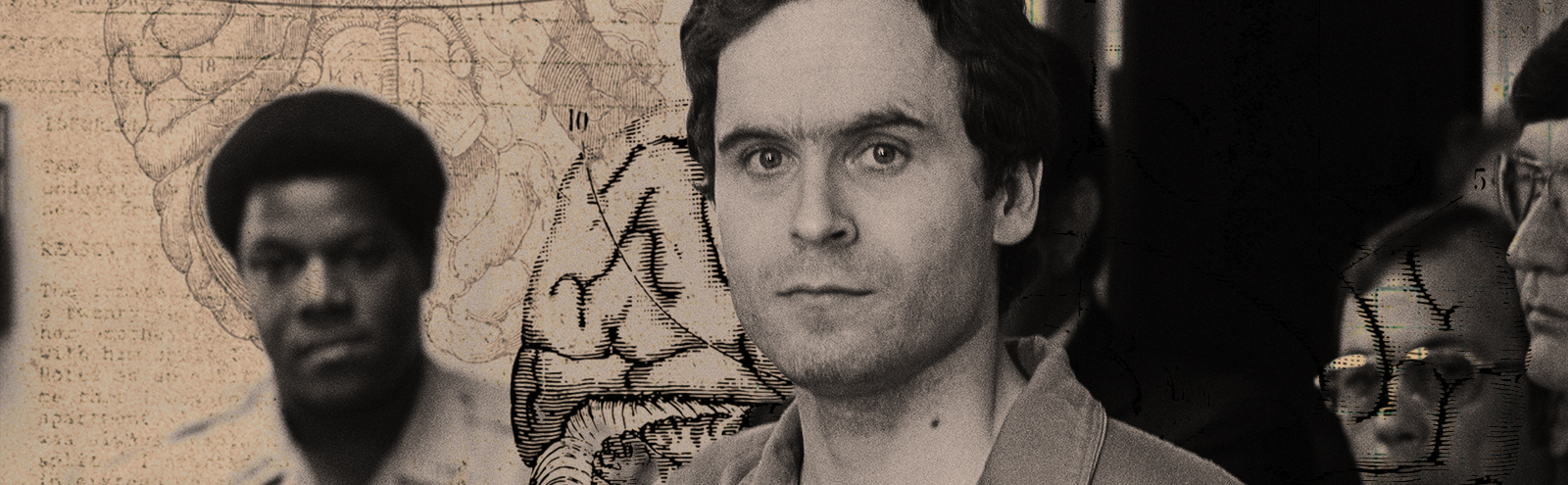
2019 saw the release of a pair of Ted Bundy movies on Netflix: Extremely Wicked, Shockingly Evil and Vile, a biopic of sorts starring Zac Efron as Bundy, and Conversations With A Killler: The Ted Bundy Tapes, a four-part documentary about Bundy featuring interviews with the killer. Both were directed by Joe Berlinger, whose filmmaking bona fides are well established; not only did he direct the Paradise Lost documentaries that eventually led to the West Memphis Three being released from prison, he created the seminal portrayal of metal band dysfunction in Metallica: Some Kind Of Monster.
Berlinger’s Bundy movies ended up being less well-received. Perhaps because they were both based on the same impossible-to-reconcile paradox: that Ted Bundy seemed like an affable, caring guy to the people that knew him even as he was killing and raping women and keeping their heads as trophies on the sly. They gave us a Bundy’s whose inner workings would remain more or less forever opaque, which is undeniably disappointing even if it speaks to some higher truth. As Matt Zoller Seitz wrote at Vulture, The Bundy Tapes “treats Bundy as a horrifying void of a man whose true emotional interior remains just out of sight, a Kurtz hidden in moral and psychological gloom no matter how much light is cast by detectives, reporters, and childhood friends.”
I saw Extremely Wicked myself at Sundance and had similar thoughts. That Bundy could at least feign normalcy — the boy-next-door killer, more or less — is the gist of almost every story about him, from Wicked and the Bundy Tapes to memoirs by Bundy ex-live-in girlfriend Elizabeth Kendall (The Phantom Prince: My Life With Ted Bundy, upon which Extremely Wicked was based) and Bundy friend Ann Rule (The Stranger Beside Me). As Berlinger described it to the LA Times, “Bundy defied all stereotypes of what a serial killer was.”
Alex Gibney’s latest documentary, Crazy, Not Insane, which was just released on HBO, seems to challenge that assumption. (Note: spoilers to follow, if you believe that discussing something in a documentary counts as a spoiler).
The documentary is a profile of forensic psychiatrist Dorothy Otnow Lewis, who has spent her career studying serial killers to see what makes them tick. While Bundy himself and to some extent both of Berlinger’s Bundy movies perpetuated the notion that Bundy had a fairly normal childhood, Otnow, who throughout her career has attempted to identify and explore the then-controversial diagnosis of dissociative identity disorder, describes something much different. Otnow, who conducted a four-hour interview with Bundy the day before his execution in 1989, initially found no neurological problems, just some “abnormalities seen in depressives.”
This is important considering the general thrust of Otnow’s career. According to Otnow, serial killers virtually always have observable neurological defects caused by childhood abuse or trauma. However, Otnow goes onto explain where her 1989 diagnosis was wrong, or at least, incomplete. Based on her interviews with family members, Bundy’s aunts described how Ted, at three years old, would come into their rooms and place kitchen knives around them under their bedcovers. She also relates a family history that included a Bundy grandmother who had received electro-shock treatment for depression, and interviews with Bundy’s mother, revealing that Bundy’s father (whose identity is still unknown) had taken her to an abortion doctor and given her pills that were supposed to result in an abortion — which didn’t work. Bundy’s mother initially tried to put the baby up for adoption, but ended up bringing him home again, where he was eventually raised to believe his grandfather was his father and his mother his older sister.
Bundy’s grandfather-father was, in turn, “a violent and disturbed man” with an extremely violent temper. Otnow also relates a story about Bundy telling her about a sexual encounter Bundy had had with his sister during childhood. The “smoking gun,” of sorts, is a box of letters delivered to Otnow by Bundy’s ex-wife years after his death, in which Otnow shows that Bundy would often sign his letters under different names, notably as “Sam,” the name of his own abusive grandfather. This last piece of evidence is Otnow’s justification for a belated diagnosis of dissociative identity disorder.
That Otnow has spent her career trying to promulgate the central idea that “killers are made, not born” may suggest treating these revelations with a grain of salt, seeing as they do tend to confirm her biases. Yet it’s hard to watch Crazy, Not Insane and not feel like it’s filling some important blanks in last year’s Bundy movies.
Berlinger’s movies are studiously factual and focus, fairly, on the aspect of Bundy as a guy who you might come away from thinking he was a normal, caring person, even to many people who were close to him. Yet it’s missing the connective tissue between normal guy and psycho killer. Surely that paradox was part of what he was attempting to explore in the films, but it ends up feeling like he’d set up a big mystery and pointedly left it unsolved. Otnow’s analysis in Crazy, Not Insane, offers perhaps some false catharsis in that sense. It “solves” Bundy, to some degree, inviting us as viewers to think “Aha! I knew there was something really off about that guy who murdered 30 women and had sex with corpses!”
We surely wouldn’t have been able to know that just from meeting Ted Bundy, or maybe even knowing him fairly intimately. In that sense, Berlingers’ movies are more fair to Bundy’s surviving acquaintances, and don’t allow us to separate ourselves from Bundy acquaintances, as gullible or as victims, or from Bundy, as something different than the everyday human beings we interact with every day.
Yet it also seems slightly… off for The Ted Bundy Tapes to leave us only with Otnow’s 1989 diagnosis of Bundy. She appears briefly in the Ted Bundy Tapes, offering the anti-climactic new diagnosis of Bundy as a manic depressive, without any of the later information described in Crazy, Not Insane. At one point, the lawyer for Bundy’s last appeal says of Otnow, “she was extremely confident that there was something unique in Ted’s brain that had led to this.”
That’s the last we hear about Otnow in The Ted Bundy Tapes, naturally leading us to conclude that she was wrong and there was nothing unique in Ted’s brain. In his LA Times interview, Berlinger described deliberately leaving some new information out of The Bundy Tapes (without saying what it was) “that we decided not to use because it would be new to the public and that wouldn’t be fair.”
Yet wasn’t there something unique in Bundy’s brain? He may have been unique in his ability to pose as a normal, everyday fellow, even famously convincing the judge of it in the trial depicted in Extremely Wicked, Shockingly Evil And Vile. But it seems just as important to note that Bundy wasn’t exactly a normal guy. At least as Otnow argues it, Bundy was an unwanted child raised in an incestual household by an abusive family who had once tried to abort him.
Maybe that’s reductive in some way. Maybe every generation has their own explanation for Ted Bundy, whether it’s pornography (as Bundy told James Dobson in the 80s), genetic psychopathy, or the trauma-induced DID Otnow alleges. We’ll have to come back to that one in 10 years. For now, Crazy, Not Insane feels like it completes a sketch that Extremely Wicked and The Ted Bundy Tapes started but left notably unfinished.
‘Crazy, Not Insane’ is available now via HBO. Vince Mancini is on Twitter. You can access his archive of reviews here.
Taylor Swift famously loves to hide Easter eggs in her music and promotional materials, and there was a big one in Folklore. Her Bon Iver collaboration, “Exile,” was co-written by the two artists, along with somebody named William Bowery. Swift fans speculated that the real identity of this mysterious songwriter was Swift’s boyfriend Joe Alwyn, a theory that Swift has finally confirmed.
Swift’s new concert film, Folklore: The Long Pond Studio Sessions, premiered on Disney+ last night, and aside from the performances, it also includes conversations between Swift, Jack Antonoff, and Aaron Dessner. During one of those chats, Swift confirmed the identity of Bowery, saying, “There’s been a lot of discussion about William Bowery and his identity because it’s not a real person. […] So, William Bowery is Joe, as we know. And Joe… Joe plays piano beautifully, and he’s always just playing and making things up and kind of creating things.”
| Taylor Swift has confirmed that William Bowery is her boyfriend Joe Alwyn #folkloreOnDisneyPlus
“It’s not a real person. So, William Bowery is Joe, as we know. Joe plays piano beautifully (…) #exile was crazy because Joe had written the entire piano part.” pic.twitter.com/Z9gkykz10S
She continued, “It was a step that we would never have taken because why would we have ever written a song together? So this was the first time we had a conversation where I came in and I was like, ‘Hey, this could be really weird, and we could hate this, so because we’re in quarantine and there’s nothing else going on, could we just try to see what it’s like if we write this song together?’”
Swift also released audio from the film as a live album, so stream that below.
There’s a good chance Aubrey Plaza has appeared in one of your favorite movies or shows. There’s an even better chance that she’s one of the reasons why you love it so much. Since her Emmy-worthy deadpan performance as April on Parks and Recreation, Plaza has worked with Edgar Wright (Scott Pilgrim vs. the World) and the Muppets (Muppets Now), hosted the Independent Spirit Awards twice, starred in Legion, voiced Eska on The Legend of Korra, and become the “new queen of indies,” thanks to Life After Beth, Ingrid Goes West, and the upcoming Black Bear, which looks very good. Also, Plaza voiced Grumpy Cat in the Lifetime original movie Grumpy Cat’s Worst Christmas Ever, and still has a career. That’s how much people like Aubrey Plaza, who’s finally getting the appreciation she deserves.
In director Clea DuVall’s queer romantic-comedy Happiest Season, Kristen Stewart plays Abby, who plans to propose to her girlfriend Harper (Halt and Catch Fire great Mackenzie Davis) until she learns that her partner hasn’t come out to her family. Also complicating matters is the presence of Harper’s ex-girlfriend Riley, played by Plaza. She’s been trending all morning on Twitter for her performance in the delightful Hulu movie, as she should. Plaza stands out even in a stacked cast with Stewart, Davis, Dan Levy, Alison Brie, Mary Holland, Victor Garber and Mary Steenburgen.
It’s not Happiest Season — it’s Aubrey Plaza season.
HELP! my mom just came in my room & said “you’re up early” & i was like “i never slept” & she was like “why????” & i was like “i got distracted…by things” …things being aubrey plaza & happiest season
When the Recording Academy releases its annual list of Grammy nominees (as it did yesterday), there’s always backlash. It felt particularly potent this year, though, since The Weeknd, who put out some of the most commercially and critically successful music of the year, was somehow completely absent from the nominations. He wasn’t the only superstar missing from the list, though, as Cardi B’s “WAP,” perhaps the biggest single of the year, isn’t up for any Grammys. There’s a good reason for that, however: Cardi didn’t actually submit the song for consideration, and now she has explained why.
Yesterday, she said in an Instagram Live video:
“Stop playing with me. Like I said, I’m never pressed for a Grammy, but y’all are not gonna take away something that I know that I worked my ass off that I deserve. If I was pressed for a Grammy. I would have submitted ‘WAP’ for this year, and I didn’t submit it. I didn’t submit it. I didn’t want to be submitted to award shows until I put out my album because I think my album is so good, and it just means something and I worked on it a lot. I’ve been working on it for almost two years. Some songs are so emotional to me because I did them during quarantine. I’m not pressed or nothing, but y’all not gonna keep doing this sh*t constantly, constantly because y’all are upset. Y’all cannot take my success.”



 | Taylor Swift has confirmed that William Bowery is her boyfriend Joe Alwyn